What are Shadow Work Prompts?
Shadow work prompts are structured introspective questions designed to uncover unconscious emotional triggers,expose the beliefs driving them,and guide an individual through a progressive process of awareness, deconstruction, integration and behavioral alignment.
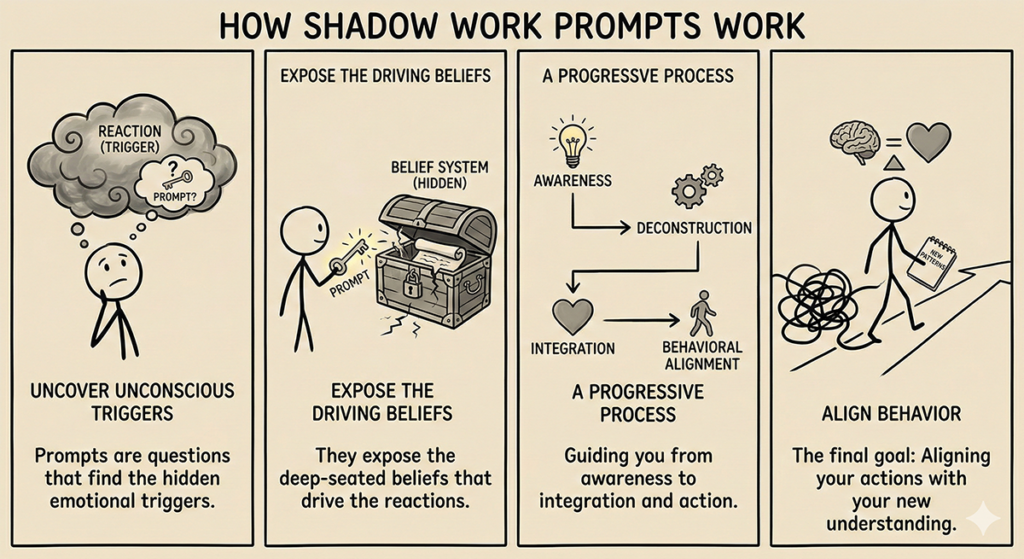
They are not random journal questions. They are diagnostic tools.
Shadow work prompts are not meant to make you feel better in the moment. They are designed to expose the internal mechanics behind your reactions so you can rebuild them intentionally.
You’ve probably tried the pretty journal prompts.
The ones with pastel gradients and cursive fonts asking you what your inner child needs to hear today.
And maybe they felt nice for a minute. But they didn’t stop you from:
- Snapping at your kid when they asked for help with homework
- Spiraling after seeing your ex’s new relationship on Instagram
- Shutting down when your roommate brought up splitting bills
- Getting defensive when your sibling criticized your parenting
- Rage-texting your landlord at 2 AM
- Making the cashier’s bad day your personal attack
- Turning a simple question from your partner into a three-day silent treatment
Here’s why:
Most shadow work prompts are designed to make you feel seen, not to make you see yourself.
And there’s a massive difference.
Shadow work prompts are structured questions designed to expose unconscious reactions in real situations.
This is done in order to force confrontation with the patterns running your life on autopilot.
This is the complete guide to shadow work prompts that actually change outcomes.
Not someday. Right now.
In the exact moment when your nervous system is trying to take the wheel.
What Shadow Work Prompts Actually Are (And What They’re Not)
They’re Not Reflection Prompts
Reflection prompts ask you to think about your feelings.
Shadow work prompts corner you into admitting what you’re actually doing.
Reflection prompt:
“What emotions came up for me today?”
Shadow work prompt:
“What did I just defend that didn’t need defending?”
See the difference?
One lets you float above the mess.
The other drags you into it.
They’re Not Therapy Questions
Therapy questions explore the why behind patterns, often diving into childhood, attachment styles, root causes.
Shadow work prompts expose the what and when. This is the exact mechanism triggering your reaction.
Therapy question:
“How does this feeling connect to your relationship with your parents?”
Shadow work prompt:
“What story am I telling myself to avoid feeling this feeling right now?”
Both are valuable. But they serve completely different purposes.
They’re Interception Tools
Shadow work prompts are designed to be used in the moment.
Not three hours later when you’ve calmed down.
Not the next morning when you’re “ready to process.”
Right when the heat is rising in your chest and you’re about to:
- Snap at your kid over spilled juice
- Send a text you’ll regret to your ex
- Shut down when your roommate brings up rent
- Lash out at your partner for asking a simple question
- Make a scene at the DMV because the wait is making you feel invisible
That’s when the prompt does its work.
Shadow Work Prompts Across Every Part of Life
Shadow work isn’t just for people with office jobs and therapy budgets.
It’s for anyone who’s ever reacted bigger than the moment required.
For Parents and Caregivers
The moment: Your toddler has a meltdown in Target. You feel every eye on you. You’re about to lose it.
The prompt: “What am I making this mean about me?”
The shift: You realize you’re defending your competence as a parent to strangers who don’t care. You focus on your kid, not the imaginary judgment.
For People Managing Money Stress
The moment: Your card declines. Your friend offers to cover lunch. You feel rage instead of gratitude.
The prompt: “What’s the thing I’m not saying because I’m afraid of how it will make me look?”
The shift: You see you’re protecting your pride at the cost of connection. You accept the help. The shame passes faster than the resentment would have.
For Anyone Navigating Family Dynamics
The moment: Your mom gives unsolicited advice. Again. You’re about to snap or shut down completely.
The prompt: “What am I actually defending right now?”
The shift: You realize you’re defending your autonomy against a threat that ended 15 years ago. You respond as an adult, not a teenager fighting for independence.
For Students and People Starting Out
The moment: Someone questions your choice of major, career path, or gap year. You feel judgment everywhere.
The prompt: “What story am I telling myself about their intentions and what evidence do I actually have?”
The shift: You see you’re assuming they think you’re failing. But they might just be curious. The defensiveness drops.
For People Between Jobs or Rebuilding
The moment: Someone asks “So what do you do?” at a party. You feel invisible. Worthless.
The prompt: “What would change if I stopped making this about my worth?”
The shift: You see you’re outsourcing your value to a job title. You answer honestly without the shame spiral.
For Anyone in Dating or New Relationships
The moment: They take 4 hours to text back. You’ve already written the breakup speech in your head.
The prompt: “What story am I telling myself to avoid feeling what I’m actually feeling?”
The shift: You see you’re building a narrative (they’re losing interest) to avoid vulnerability (I’m scared they’ll leave). You wait. You feel the fear without feeding the story.
For People Managing Chronic Illness or Disability
The moment: Someone says “But you don’t look sick.” You want to scream or cry or both.
The prompt: “What would I say if I wasn’t afraid of how it will make me look?”
The shift: You realize you’re afraid of seeming dramatic or difficult. You speak your truth without apologizing for it.
For Anyone Dealing With Grief or Loss
The moment: Someone says “Everything happens for a reason.” You feel rage.
The prompt: “What part of me just tried to control something I can’t control?”
The shift: You see you’re trying to control their words because you can’t control the loss. You let the comment pass. You don’t need them to understand.
For Roommates and Housemates
The moment: Your roommate didn’t do their dishes. Again. You’re about to leave a passive-aggressive note.
The prompt: “What boundary would I set if I wasn’t afraid of conflict?”
The shift: You see you’ve been avoiding a direct conversation because conflict feels dangerous. You ask to talk. The dishes get done or you decide to move. Either way, you stopped the silent resentment loop.
For Anyone Managing Substance Use or Recovery
The moment: Someone offers you a drink. You feel pressure to explain why you don’t drink. Or pressure to just say yes.
The prompt: “What do I need them to do that would make me feel okay—and why is that their job?”
The shift: You realize you’re trying to control their reaction to protect yourself. You say no without explanation. Their response is their business.
For People Caring for Aging Parents
The moment: Your dad refuses to use the walker. Again. You snap at him.
The prompt: “What would I have to give up to admit I’m wrong here?”
The shift: You realize you’re making this about being right (he needs the walker) instead of connection (he’s losing independence and it’s terrifying). You soften. The fight ends.
For Anyone Working Multiple Jobs or Night Shifts
The moment: Your friend complains about being tired after their 9-5. You want to throw your schedule in their face.
The prompt: “What am I defending that I don’t actually believe?”
The shift: You see you’re defending the idea that your struggle is more valid. But you don’t actually believe suffering is a competition. You let them be tired. You stay tired too. Both are true.
Shadow work isn’t about your job title or tax bracket.
It’s about the moment when your nervous system decides you’re under threat—and responds accordingly.
Whether that’s in a boardroom or a food bank.
At a PTA meeting or in the ER waiting room.
During a custody exchange or a Tinder date gone wrong.
The reaction is the same.
The prompts work the same.
And the freedom on the other side?
That’s for everyone.
Every reaction falls into one of these categories. Master these, and you can intercept almost anything.
1. Defense Prompts
Use when you’re defending something that doesn’t need defending
- What am I actually defending right now?
- What did I just make this mean about me?
- What would I have to give up to admit I’m wrong here?
- If I wasn’t trying to prove something, what would I actually say?
2. Control Prompts
Use when you’re micromanaging, over-planning, or forcing outcomes
- What part of me just tried to control something I can’t control?
- What’s the fear underneath this need for control?
- What would I stop doing if I wasn’t afraid of the outcome?
3. Narrative Prompts
Use when you’re building a story to justify how you feel
- What story am I telling myself to avoid feeling what I’m actually feeling?
- What evidence do I actually have for this story?
- What would I have to admit if I stopped blaming them?
4. Worth Prompts
Use when reactions feel like attacks on your competence or value
- What did this just activate about my worth?
- What would I need to believe about myself to not need their validation?
- What would change if I stopped making this about whether I’m enough?
5. Avoidance Prompts
Use when you’re not saying what needs to be said
- What’s the thing I’m not saying because I’m afraid of how it will make me look?
- What would I say if I wasn’t afraid of conflict?
- What boundary would I set if I wasn’t afraid of disappointing someone?
6. Projection Prompts
Use when you’re assuming intentions without evidence
- What story did I tell myself about their intentions—and what evidence do I actually have?
- What part of this is actually about them—and what part is about something much older?
- Am I reacting to what they said, or what I heard?
7. Pattern Prompts
Use when you recognize you’re doing the familiar thing again
- What’s the thing I keep doing that I’d call out in someone else?
- How many times have I reacted this exact way before?
- If this reaction were a defense mechanism, what would it be defending?
How to Actually Use Shadow Work Prompts
Step 1: Notice the Reaction
You can’t interrupt what you don’t notice.
Learn to recognize the physical sensations that show up right before you react:
- Heat in your chest
- Tightness in your throat
- Jaw clenching
- Sudden urge to leave the room
- That familiar feeling of “here we go again”
Your body knows the reaction is coming before your brain does.
Step 2: Pick ONE Prompt
Not five.
Not “the one that feels most comfortable.”
The one that makes your stomach tighten when you read it.
That’s your prompt.
Step 3: Answer in One Sentence
Write it down. Don’t just think it.
Thinking lets you lie to yourself.
Writing forces commitment.
One sentence. Raw and messy. No editing.
Step 4: Close the Notebook and Move On
You don’t need to process it further.
You don’t need to explore it for three pages.
You just needed to see it.
And once you see it clearly, the pattern starts to lose its grip.
The Difference Between Prompts That Perform vs. Prompts That Work
Prompts That Perform:
- “What does my inner child need to hear?”
- “How can I show myself more compassion today?”
- “What limiting beliefs are holding me back?”
- “What am I grateful for in this moment?”
These prompts are designed to make you feel something, not change something.
They’re emotional comfort food.
And there’s nothing wrong with comfort, when that’s what you need.
But if you want to stop reacting the same way every time someone questions you?
You need prompts that work.
Prompts That Work:
- “What did I just defend that didn’t need defending?”
- “What story am I telling myself to avoid admitting I was wrong?”
- “What part of me just tried to control the outcome?”
- “What’s the thing I’m not saying because I’m afraid of how it will make me look?”
These prompts don’t make you feel better.
They make you see better.
And seeing clearly is the only way forward.
Real-World Examples: Shadow Work Prompts in Action
Example 1: The Text From Your Mom That Made You Snap
The Situation:
Your mom texts asking if you’re coming to Sunday dinner. It’s a simple question. But you read it as judgment about how rarely you visit.
The Prompt:
“What did I just make this mean about me?”
The Answer (written immediately):
“I made it mean I’m a bad daughter/son. But she literally just asked if I’m coming. That’s it.”
The Result:
You see the gap between what was said and what you heard. You respond without the defensive edge. Sunday dinner happens without the tension you created in your own head.
Example 2: The Fight With Your Teenager That Didn’t Need to Happen
The Situation:
Your kid says “You don’t understand” and rolls their eyes. You feel rage rising.
The Prompt:
“What am I actually defending right now?”
The Answer:
“My competence as a parent. Because ‘you don’t understand’ sounds like ‘you’re failing.'”
The Result:
You realize they’re just frustrated and not attacking your entire parenting history.
You respond: “You’re right, help me understand.” The conversation opens instead of shutting down.
Example 3: The Grocery Store Meltdown You Almost Had
The Situation:
You’re in the checkout line. Your card declines. The person behind you sighs audibly. You feel humiliation turning into rage.
The Prompt:
“What’s the thing I’m not saying because I’m afraid of how it will make me look?”
The Answer:
“I’m embarrassed. I feel broke and exposed. And I’m about to make this stranger the villain so I don’t have to feel the shame.”
The Result:
You see what’s actually happening. You run the other card. You don’t make eye contact with the person behind you and turn this into something it’s not. You leave without carrying the interaction for three days.
25 Shadow Work Prompts Ready to Use Right Now
When You’re Defending
- What am I actually defending right now?
- What did I just make this mean about me?
- What would I have to give up to admit I’m wrong here?
- What am I defending that I don’t actually believe?
- If I wasn’t trying to prove something, what would I actually say?
When You’re Controlling
- What part of me just tried to control something I can’t control?
- What’s the fear underneath this need for control?
- What would I stop doing if I wasn’t afraid of the outcome?
- What am I trying to prevent by controlling this?
- What would have to be true for me to let this go?
When You’re Building Stories
- What story am I telling myself to avoid feeling what I’m actually feeling?
- What evidence do I actually have for this story?
- What story did I tell myself about their intentions—and is it true?
- What would I have to admit if I stopped blaming them?
- Am I reacting to what they said, or what I heard?
When It’s About Worth
- What did this just activate about my worth?
- What would I need to believe about myself to not need their validation?
- What would change if I stopped making this about whether I’m enough?
- What part of me just made this about my competence instead of the task?
- If I believed I was already enough, how would I respond differently?
When You’re Avoiding
- What’s the thing I’m not saying because I’m afraid of how it will make me look?
- What would I say if I wasn’t afraid of conflict?
- What boundary would I set if I wasn’t afraid of disappointing someone?
- What do I need them to do that would make me feel okay—and why is that their job?
- If I let this go without making them understand, what would I lose?
Common Mistakes People Make With Shadow Work Prompts
Mistake #1: Answering Prompts Like School Assignments
Shadow work prompts aren’t graded.
You don’t get points for eloquence or depth.
The goal is honesty, not performance.
If your answer is messy, good.
If it’s uncomfortable, better.
If it makes you look bad on paper, you’re doing it right.
Mistake #2: Using Prompts When You’re Already Calm
Prompts work best when used immediately after a reaction.
Not three hours later when you’ve edited the story.
Not the next morning when you’re “ready to process.”
Right when the feeling is still hot.
That’s when the truth is clearest.
Mistake #3: Turning One Prompt Into a Therapy Session
One prompt. One or two sentences. Done.
If you’re writing three pages in response to a single prompt, you’re ruminating—not intercepting.
The point is to see the pattern, not to excavate your entire psychological history.
Mistake #4: Only Using Prompts You’re Comfortable With
The prompt that makes you uncomfortable is the one you need.
If a question makes your stomach tighten when you read it, that’s your cue.
That’s the one exposing the thing you’ve been avoiding.
Use that one.
Mistake #5: Expecting Prompts to “Fix” the Feeling
They won’t.
Shadow work prompts don’t make you feel better.
They make you see better.
The discomfort might stay. The reaction might still want to happen.
But once you see the mechanism, it loses power.
Frequently Asked Questions About Shadow Work Prompts
What’s the difference between shadow work prompts and regular journal prompts?
Regular journal prompts invite exploration: “How do I feel about this?” Shadow work prompts force confrontation: “What am I defending that I don’t actually believe?” One is open-ended reflection. The other is targeted intervention.
How often should I use shadow work prompts?
Use them when you react, not on a schedule. If you have a day with no big reactions, you don’t need to force it. If you have a day with three reactions, use a prompt for each one. The practice is responsive, not prescriptive.
Can I create my own shadow work prompts?
Yes—but only if they follow the same structure: they should expose the mechanism, not invite reflection. Good prompts corner you. Bad prompts let you circle feelings without landing. Test: Does the prompt make you squirm? If yes, it’s probably good.
What if I answer a prompt and still react the same way next time?
That’s normal. Shadow work isn’t about immediate behavior change—it’s about noticing sooner. The first 10 times, you’ll react and then realize it afterward. Eventually, you’ll catch yourself mid-reaction. And eventually, you’ll catch yourself before the reaction launches. It’s progression, not transformation.
Do I have to write my answers down, or can I just think them?
Writing is better. Thinking lets you lie to yourself. Writing forces you to commit to an answer—and that answer becomes harder to ignore when you see it on the page. If you can’t write in the moment, use a voice note. But thinking alone is too slippery.
What if using prompts makes me feel worse?
If answering a prompt makes you spiral into shame, self-criticism, or hopelessness, stop. You’ve crossed from shadow work into rumination. Shadow work should feel uncomfortable but clarifying—not crushing. If it’s making you feel worse, you either went too deep or stayed too long. Keep answers short. One question. One sentence. Then move on.
Are shadow work prompts the same as CBT or therapy techniques?
They’re related but different. CBT focuses on identifying and restructuring cognitive distortions. Shadow work prompts focus on intercepting unconscious reactions in real time. There’s overlap, but shadow work is more about immediate pattern interruption than long-term belief restructuring.
Can I use these prompts with other people in conflict?
No. These are self-interrogation tools, not relationship tools. Asking your partner “What are you defending that you don’t actually believe?” will start a fight, not resolve one. Use these on yourself only.
How do I know which prompt to use?
Pick the one that makes you most uncomfortable. If you’re avoiding a question or explaining why it doesn’t apply to you, that’s the one you need. The resistance is the tell.
What if none of the prompts feel relevant to my situation?
Then you’re probably not being honest about what just happened. Reread the list and notice which one you’re actively avoiding. That’s your prompt. If you still can’t find one, the issue might not be a shadow work moment—it might be a situation that needs action, not introspection.
Advanced Prompt Strategies: When Basic Prompts Aren’t Enough
Strategy 1: Chain Prompts for Deeper Patterns
Sometimes one prompt reveals a surface pattern, but there’s something underneath.
Example:
- First prompt: “What am I defending?” → Answer: “My reliability.”
- Second prompt: “What would I have to give up to admit I’m wrong here?” → Answer: “My identity as the person who always follows through.”
- Third prompt: “If I wasn’t trying to prove something, what would I actually say?” → Answer: “I forgot. I’m sorry.”
Chaining reveals layers you’d miss with a single question.
Strategy 2: Use Prompts to Pre-Empt Known Triggers
If you know certain situations always trigger you (family dinners, performance reviews, specific people), use prompts before the trigger happens.
Before the triggering event:
“What part of me is already preparing to defend itself and why?”
This creates awareness before the autopilot takes over.
Strategy 3: Reverse Engineer Your Justifications
If you catch yourself mid-justification, flip it into a prompt.
You’re saying: “They always do this, so of course I reacted that way.”
Flip it: “What would I have to admit if I stopped blaming them?”
Turn your excuses into questions.
The Science Behind Why Shadow Work Prompts Actually Work
They Interrupt Automaticity
Most reactions are automatic. Your nervous system fires before conscious thought kicks in.
Prompts create a gap between trigger and response.
That gap is where choice lives.
They Externalize Internal Narratives
When you think a justification, it stays fluid. You can edit it, dodge it, rationalize it.
When you write it in response to a prompt, it becomes fixed.
And fixed narratives are easier to examine and dismantle.
They Bypass Intellectual Defense
Your brain is excellent at defending itself through logic.
But prompts don’t argue with you.
They just ask a question and wait.
And questions are harder to argue with than statements.
They Build Pattern Recognition Over Time
One prompt answered once doesn’t change much.
The same prompt answered ten times reveals a pattern.
And once you see the pattern clearly enough, the autopilot starts to glitch.
How to Build a Shadow Work Prompts Practice That Actually Sticks
Week 1-2: Just Notice
Don’t try to change anything.
Just notice when you react bigger than the situation requires.
Pick one prompt. Answer it. Move on.
The goal is awareness, not transformation.
Week 3-4: Notice Sooner
Start paying attention to the early warning signs.
The heat in your chest before you snap.
The tightness in your throat before you shut down.
Use prompts the moment you feel the reaction starting.
Week 5-8: Attempt Interruption
Now that you can notice the reaction sooner, try pausing.
Even two seconds of silence is enough to stop the autopilot.
Use a prompt during the pause.
You won’t succeed every time. That’s fine.
Week 9-12: Track Patterns
Review your answers weekly.
Look for recurring themes:
- Same trigger, same reaction
- Same defense, different situation
- Same story, different person
The pattern becomes undeniable.
And once it’s undeniable, change becomes possible.
Where to Go From Here
If you want the complete system:
Our full shadow work system includes:
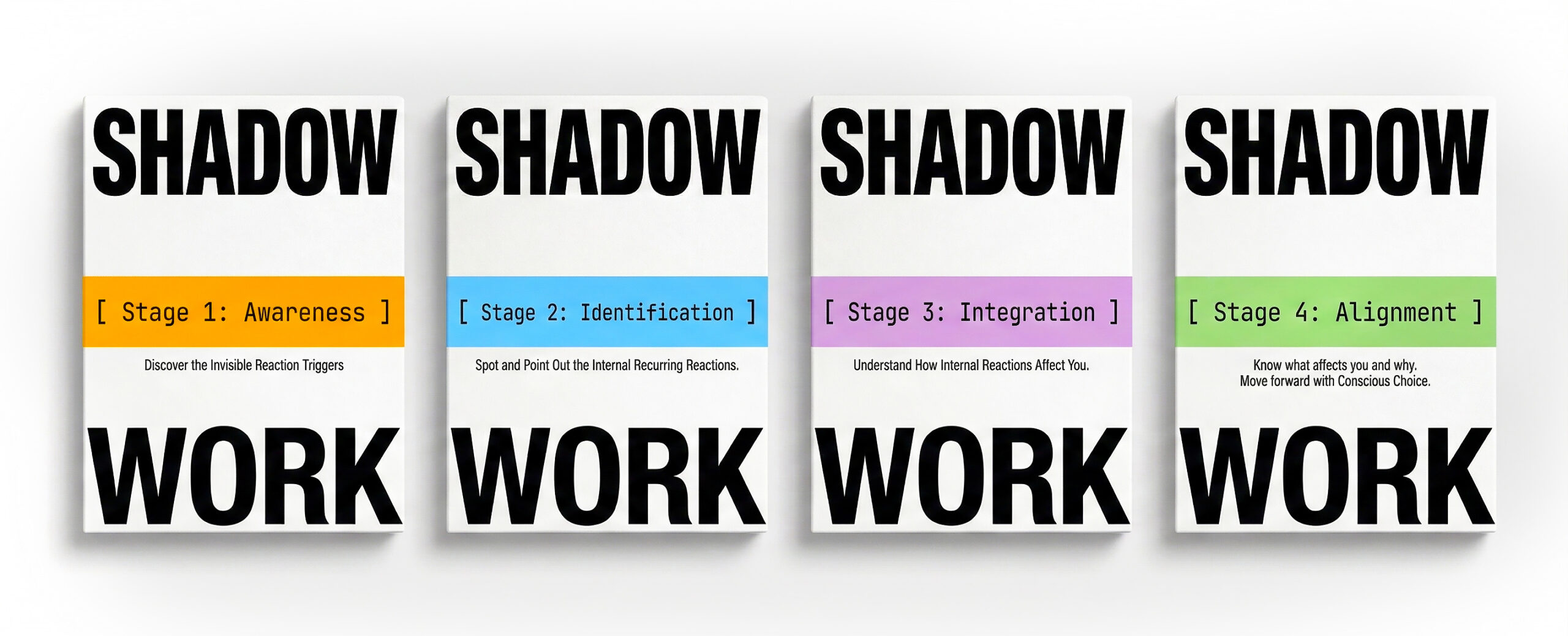
The 4-Stage Shadow Work System
This system is the first step in a sequenced, professional-grade psychological framework:
Option 1: The Full Shadow Work System (4 Stages)
Option 2:
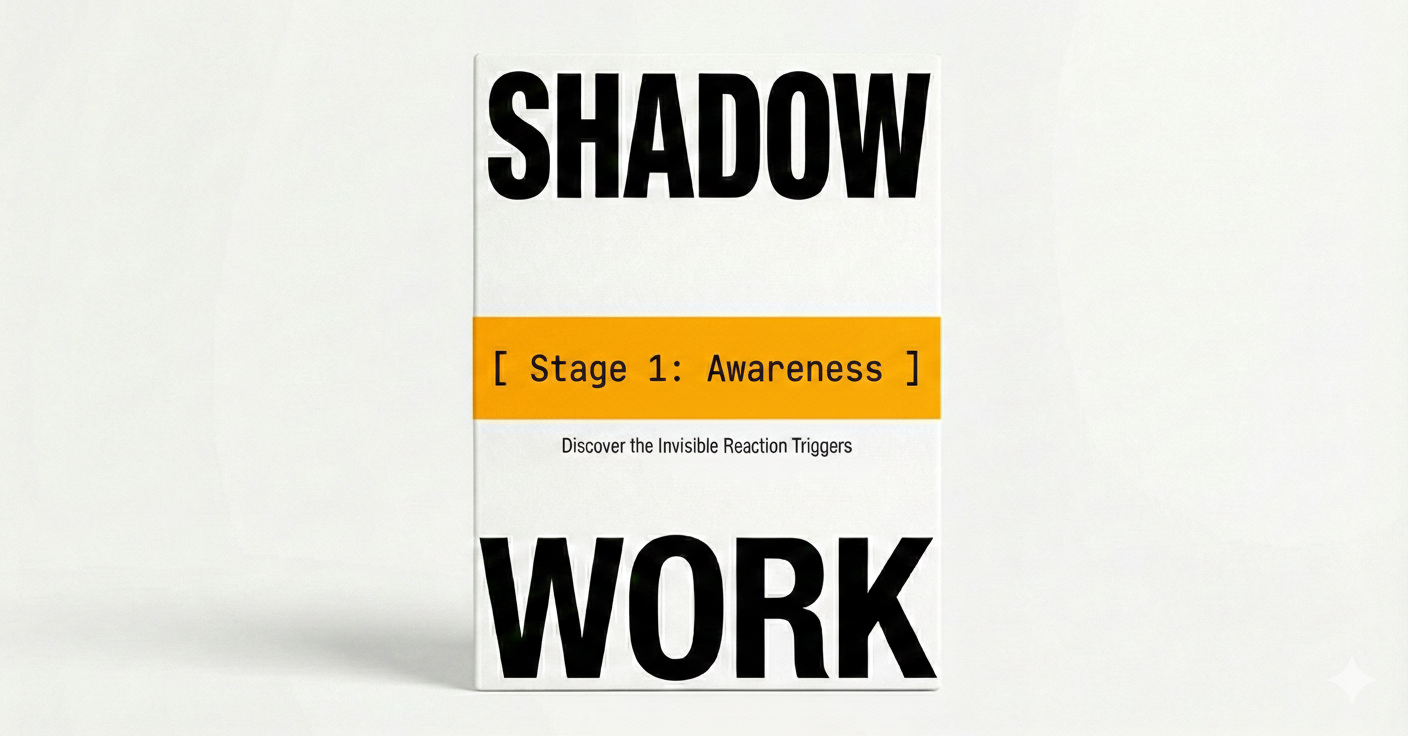
Start with one stage and then move onto the next, one at a time ,from within the system.
- Stage 1: Awareness – Discover the Invisible Reaction Triggers.
- Stage 2: Identification – Spot and Point Out the Internal Recurring Reactions.
- Stage 3: Integration – Understand How Internal Reactions Affect You.
- Stage 4: Alignment – Know what affects you and why. Move forward with Conscious Choice.
- Comprehensive prompt library (100+ prompts organized by category)
- Daily interception exercises
- Pattern tracking templates
- Weekly review protocols
- Monthly progress analysis
- Real-time reaction logs
If you want individual deep-dives into specific types of prompts:
Shadow Work Prompts That Don’t Waste Your Time
The 7 most powerful prompts with detailed breakdowns.
Shadow Work Journal Prompts for When Writing Finally Clicks
Prompts organized by trigger type: conflict, authority, rejection, pressure.
Shadow Work Questions That Cut Straight Through the Noise
Short, brutal questions that dismantle narratives in one sentence.
If you want to understand the broader context:
What Is Shadow Work? (And Why It Shows Up When You Least Expect It)
Start here if you’re new to shadow work.
How to Do Shadow Work Without Turning It Into a Personality Project
The step-by-step interception process.
The Final Truth About Shadow Work Prompts
They will make it impossible to pretend you don’t see the repeat impulses.
And once you see it clearly enough. Once you’ve written the same answer ten times, fifteen times, twenty times, the pattern starts to crack.
Not because you wanted it to.
Because you finally stopped letting it hide. The prompts are tools. The work is yours.
And it starts the second you stop explaining yourself and start watching yourself instead.
You Can Only Fix Something if you know where to look.
Now you can find out where to look