How to Do Shadow Work Without Turning It Into a Personality Project
Let’s be honest.
You’ve probably already done a lot of “inner work.”
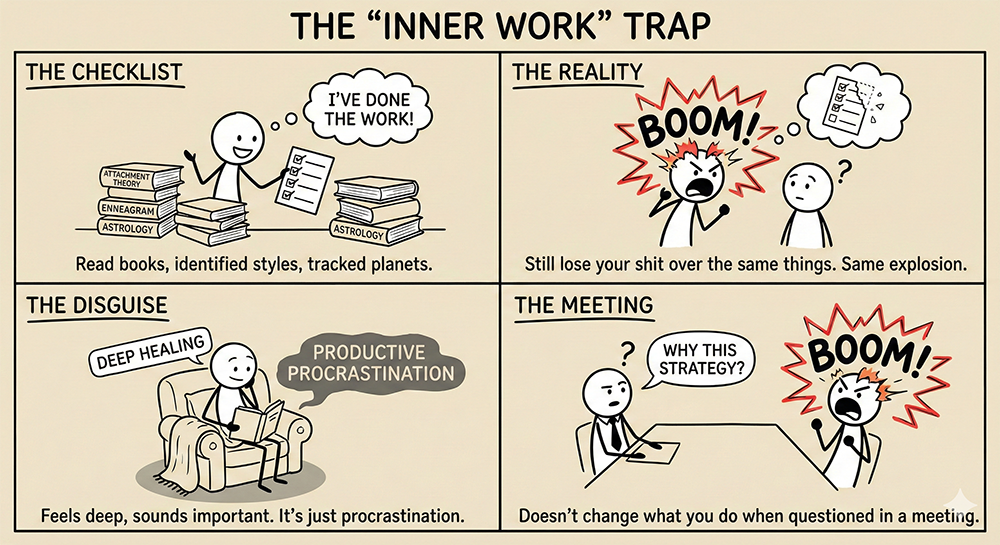
You’ve read the books. You’ve sat with your feelings. You’ve identified your attachment style, your Enneagram number, and which planet was in retrograde when you developed trust issues.
And yet, somehow, you still lose your shit over the same things.
Different day. Different person. Same explosion.
Because here’s what no one says out loud:
Most “shadow work” is just productive procrastination disguised as healing.
It feels deep. It sounds important.
But it doesn’t change what you do when someone questions you in a meeting.
The Problem With “Working On Yourself”
Shadow work , the real kind, isn’t about working on yourself.
It’s about intercepting yourself.
There’s a difference.
Working on yourself is endless.
It’s journaling about why you feel defensive. Reading another book about inner children. Going deeper into the story of what made you this way.
Intercepting yourself is instantaneous.
It’s catching the reaction mid-launch and stopping it before it runs the show.
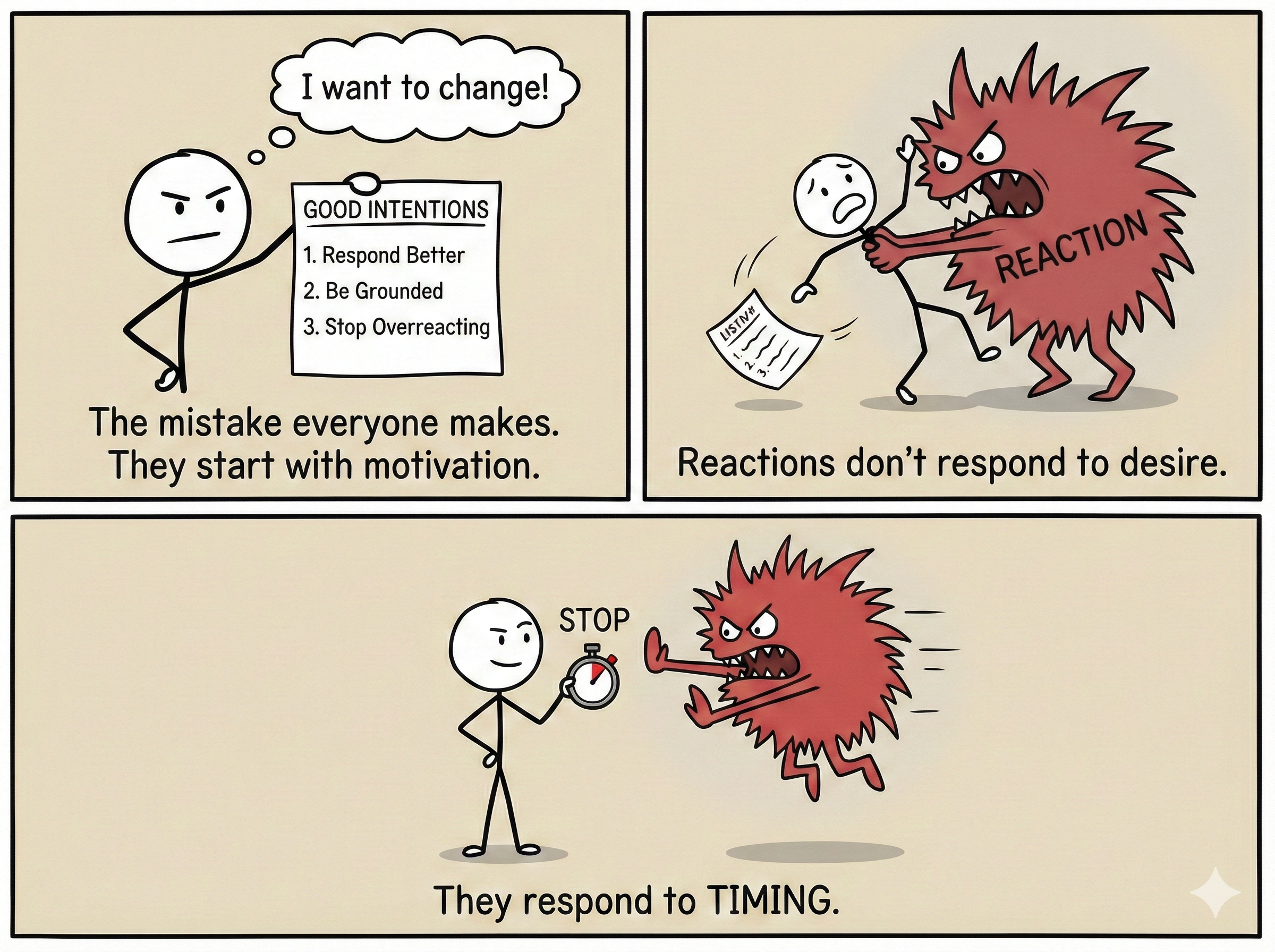
You don’t need more insight.
You need better timing.
What Shadow Work Actually Is (Without the Mysticism)
Shadow work is the practice of identifying unconscious reactions in real time and choosing a different response.
Not because you’ve “healed.”
Because you’ve practiced.
It’s a skill, not a transformation.
And like any skill, it gets better with repetition, not revelation.
Here’s what that looks like in practice:
Trigger → Reaction → Consequence
becomes
Trigger → Pause → Choice → Different Outcome
The pause is everything.
And the pause is trained, not discovered.
What Most People Do Wrong (And Why It Doesn’t Work)
Mistake #1: They Go Hunting for the Root Cause
You don’t need to excavate your childhood to stop snapping at your partner.
Yes, there’s probably something old underneath the reaction.
But you don’t need to understand it to interrupt it.
You just need to notice it’s happening.
The obsession with “why” keeps you stuck in the story instead of changing the pattern.
Mistake #2: They Wait Until They’re Calm
Shadow work doesn’t happen in a meditation app.
It happens in the exact moment when you feel the heat rising in your chest and you’re about to say something you’ll regret.
That’s the training ground.
If you only do shadow work when you’re already calm, you’re not doing shadow work. You’re doing therapy karaoke.
Mistake #3: They Think Awareness Is Enough
“I know I do this” doesn’t count.
Knowing you have a pattern and stopping mid-pattern are completely different skills.
Awareness without interruption is just spectating your own life.
What Actually Changes the Outcome
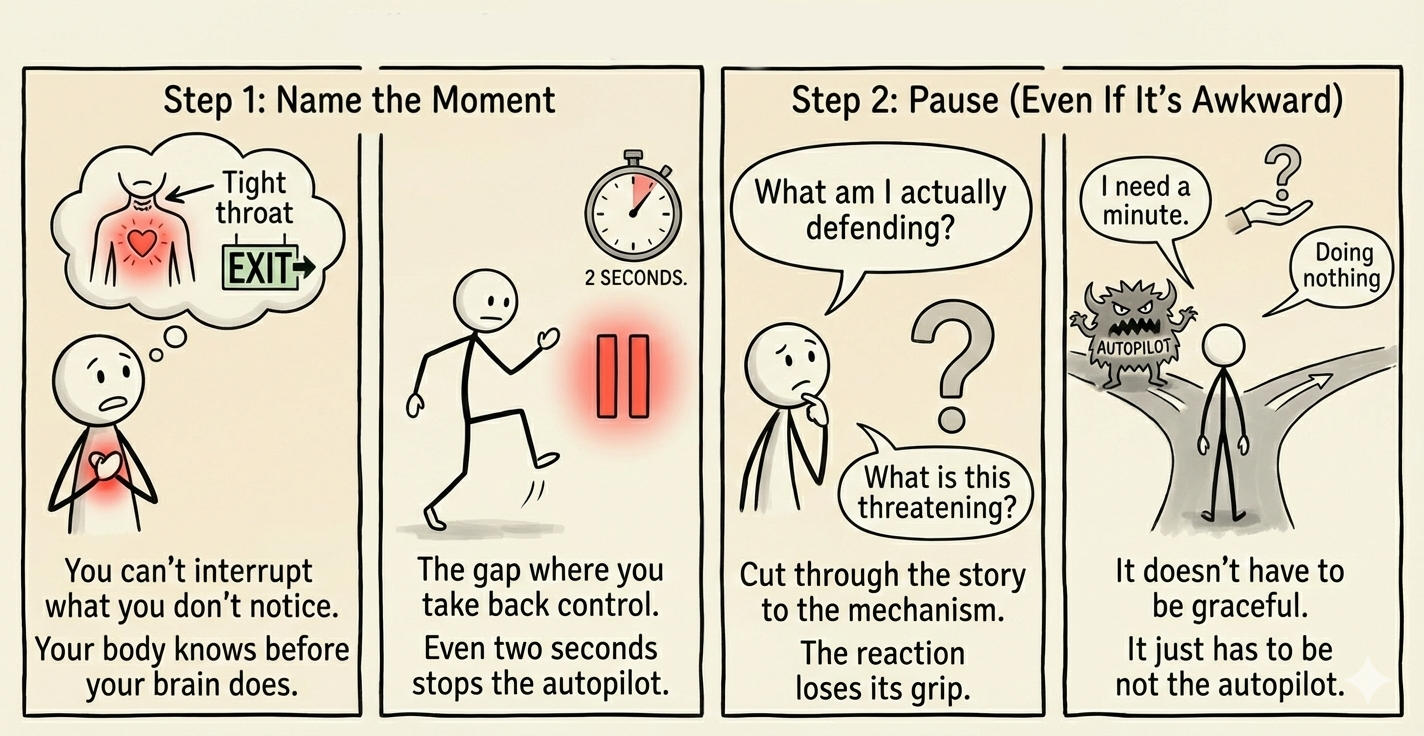
Step 1: Name the Moment
You can’t interrupt what you don’t notice.
The first skill is recognizing the physical sensation that shows up right before you react.
For some people, it’s heat in the chest.
For others, it’s a tightness in the throat or a sudden urge to leave the room.
Your body knows the reaction is coming before your brain does.
Learn your early warning system.
Step 2: Pause (Even If It’s Awkward)
This is the hardest part.
Because pausing mid-reaction feels wrong.
It feels like backing down. Like letting someone “win.”
But the pause isn’t surrender.
It’s the gap where you take back control.
Even two seconds of silence is enough to stop the autopilot from taking over.
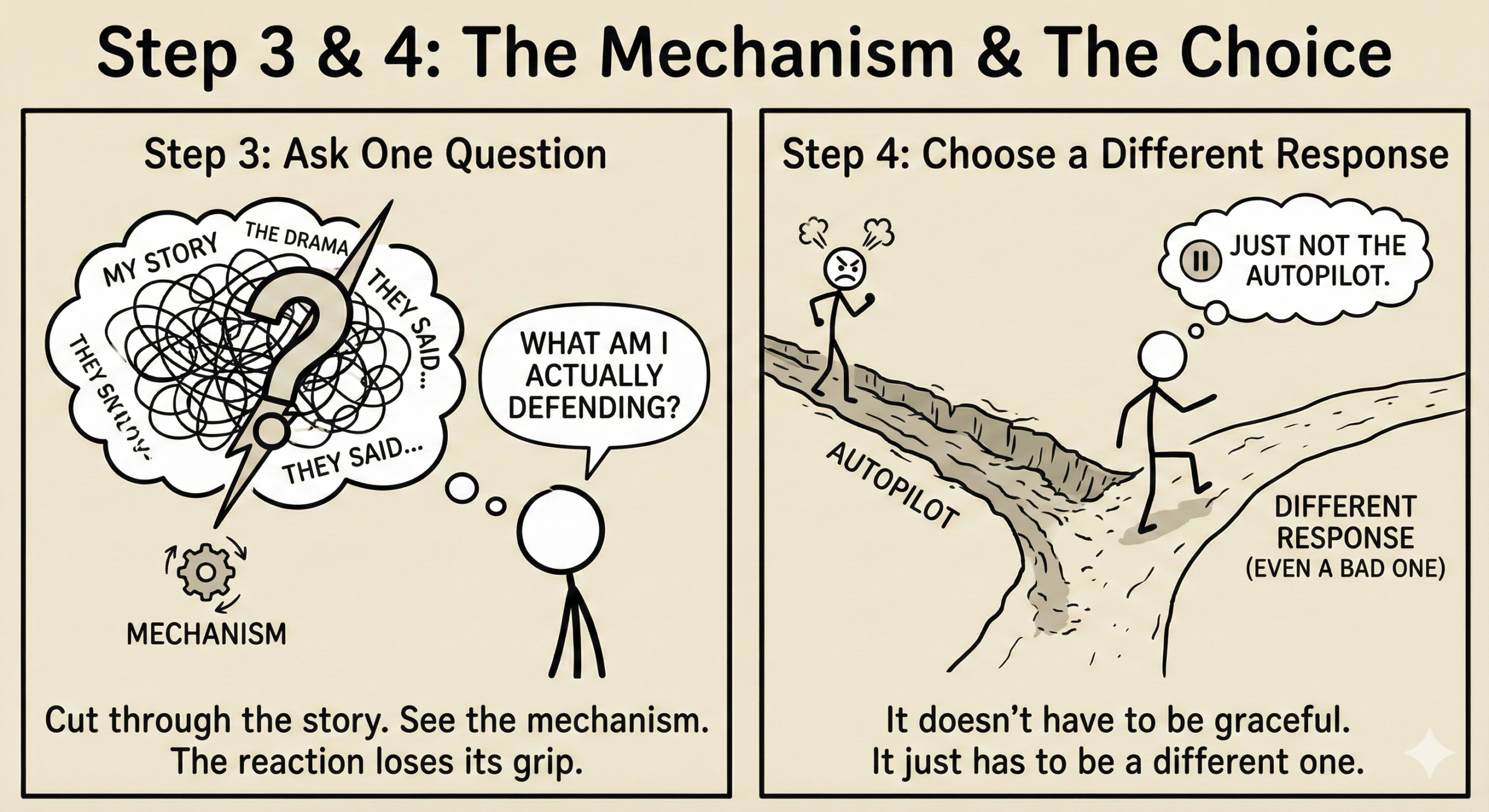
Step 3: Ask One Question
Not ten questions.
Not a deep dive into your psyche.
Just one:
“What am I actually defending right now?”
or
“What does this feel like it’s threatening?”
That question cuts through the story and gets to the mechanism.
And once you see the mechanism, the reaction loses its grip.
Step 4: Choose a Different Response (Even a Bad One)
You don’t need the perfect response.
You just need a different one.
Instead of snapping, you say nothing.
Instead of shutting down, you say “I need a minute.”
Instead of launching into defense mode, you ask a clarifying question.
It doesn’t have to be graceful.
It just has to be not the autopilot.
Why Structure Beats Motivation Every Single Time
Motivation is weather.
It comes and goes.
Shadow work only works if you do it when you don’t feel like it.
Which is why you need a system that doesn’t rely on you being in the mood.
Here’s what a real shadow work practice looks like:
Daily:
- One moment where you caught yourself mid-reaction (even if you didn’t stop it)
- One question you asked instead of reacting
Weekly:
- Review the patterns: What triggered you most this week?
- Identify the early warning signs you missed
Monthly:
- Compare this month to last month: Did the same thing trigger you? Did you respond differently?
No vision boards. No affirmations.
Just repetition until the new response becomes the default.
The Part That Makes People Uncomfortable
Shadow work doesn’t make you nicer.
It makes you less reactive.
Which sometimes means:
- You stop apologizing for things that aren’t your fault
- You stop over-explaining yourself
- You stop accommodating people who are used to you folding
And people notice.
They might even accuse you of “changing” or “being cold.”
That’s not you doing shadow work wrong.
That’s you stopping the people-pleasing autopilot.
And yes, it’s uncomfortable.
But so is spending the rest of your life letting your nervous system make decisions for you.
What Happens When You Actually Do This
You don’t become a different person.
You become the same person with better reflexes.
You still feel the anger, the defensiveness, the urge to shut down.
But you stop obeying it.
And over time, the reactions get quieter.
Not because you’ve healed some deep wound.
Because you’ve stopped feeding the loop.
Real-World Examples: What Interception Actually Looks Like
Example 1: The Email You Almost Sent
The Trigger: A colleague publicly questions your approach in a Slack channel.
The Autopilot: Draft a 6-paragraph response explaining why you’re right. Include screenshots. CC your manager.
The Interception: You feel your fingers moving toward the keyboard. Heat in your chest. Jaw tight.
You pause.
You ask: “What am I defending?”
Answer: Your competence. Because the question felt like an attack on your judgment.
You close Slack. You take a walk. You come back 20 minutes later and respond with one line: “Happy to discuss this in our 1:1 tomorrow.”
The situation de-escalates. Your reputation stays intact. You didn’t feed the loop.
Example 2: The Dinner Argument That Didn’t Happen
The Trigger: Your partner asks if you’ve done the thing you said you’d do.
The Autopilot: Snap at them. “I said I’d do it, didn’t I? Why are you checking up on me?”
The Interception: You feel the defensiveness rising. That familiar tightness in your throat.
You notice it. You pause—even though it feels awkward.
You ask: “What does this question feel like it’s threatening?”
Answer: Your reliability. Because being questioned feels like being doubted.
You respond: “Not yet, but I’ll handle it tonight.”
No defense. No story about why you haven’t done it yet. Just honesty.
The conversation continues. No fight. No repair needed later.
Example 3: The Meeting Where You Didn’t Shut Down
The Trigger: Your idea gets criticized in front of the team.
The Autopilot: Go silent for the rest of the meeting. Decide you’re never sharing ideas again. Replay the moment for three days.
The Interception: You feel yourself starting to retreat. That familiar urge to disappear.
You notice it.
You ask: “What’s the thing I’m not saying because I’m afraid of how it will make me look?”
Answer: You’re not saying that you think the criticism missed the point—because defending yourself feels risky.
You choose differently: “I hear that concern. Let me clarify what I was trying to solve for.”
You stay in the conversation. You don’t shut down. The idea gets refined instead of abandoned.
Common Mistakes People Make With Shadow Work
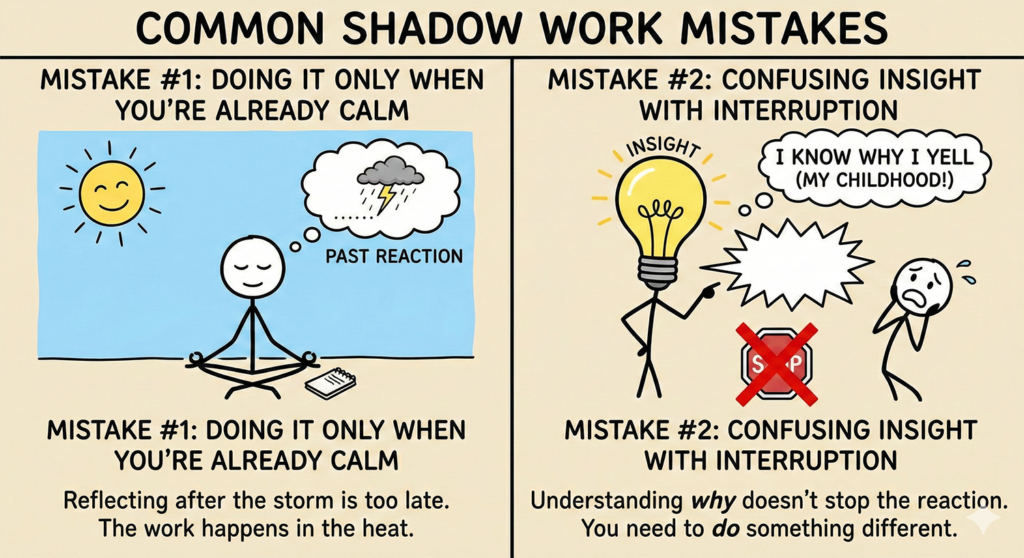
Mistake #1: Doing It Only When You’re Already Calm
The whole point is to catch yourself mid-reaction.
If you’re only reflecting after you’ve already calmed down, you’re not training the skill you actually need.
The work happens in the heat, not in the debrief.
Mistake #2: Confusing Insight With Interruption
Understanding why you react doesn’t stop you from reacting.
You can have all the insight in the world and still blow up the same conversation next week.
Shadow work is about doing something different in the moment—not understanding yourself better.
Mistake #3: Waiting to Feel “Ready”
You’re never ready.
The reaction happens whether you’re prepared or not.
Shadow work is about building the reflex to pause even when you don’t feel like it.
Waiting for motivation is just procrastination with good intentions.
Mistake #4: Trying to Stop the Feeling
You can’t.
The anger, defensiveness, or shame will show up anyway.
Shadow work isn’t about not feeling it—it’s about not obeying it.
You feel the reaction and choose a different response.
The feeling doesn’t have to go away for you to act differently.
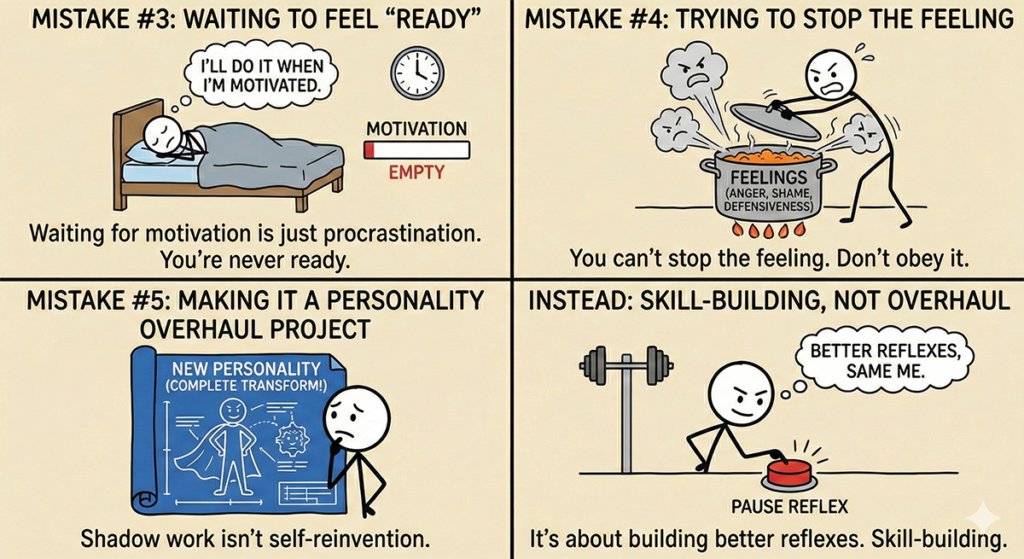
Mistake #5: Making It a Personality Overhaul Project
Shadow work isn’t about becoming a different person.
It’s about becoming the same person with better reflexes.
If you’re treating it like a transformation journey, you’ve missed the point.
It’s skill-building, not self-reinvention.
Frequently Asked Questions
How long does it take to see results from shadow work?
Most people start noticing patterns within 2-4 weeks of consistent practice. But actual behavior change—where you interrupt a reaction in real time—usually takes 8-12 weeks. The skill compounds. The more you practice, the faster you catch yourself.
Can shadow work replace therapy?
No. Shadow work is interception training, not trauma processing. If you have unresolved trauma, deep-seated mental health issues, or patterns rooted in childhood wounds, therapy is the better tool. Shadow work handles the surface-level reactions. Therapy handles the foundation. Both are valuable. They’re just different.
What if I keep failing at it?
You will. Repeatedly. That’s the process. Shadow work isn’t about perfect execution—it’s about noticing sooner. Even if you react the same way, the fact that you noticed is progress. Over time, the noticing happens earlier. And eventually, it happens early enough that you can choose differently.
Do I need to journal for shadow work to work?
No. Journaling is one method, but it’s not required. Some people use mental check-ins. Others use voice notes. The key is tracking patterns whichever way you choose to do it. The journal just makes the pattern harder to ignore.
What if shadow work makes me feel worse?
That’s not shadow work. That’s rumination. If you’re spiraling into shame, self-criticism, or endless analysis, you’ve crossed the line. Shadow work should feel uncomfortable but clarifying. If it’s making you feel worse, you’re going too deep or staying too long. Set a time limit. Keep it short. Focus on the pattern, not the wound.
Can I do shadow work if I don’t know what my triggers are?
Yes. You don’t need to know your triggers in advance. They’ll show up on their own—every time you overreact, shut down, or defend something that wasn’t under attack. Just pay attention to moments when your response is bigger than the situation requires. That’s your cue.
Where to Go From Here
If you want a system that doesn’t rely on motivation or “being ready,” start here:
Get the framework that makes shadow work automatic →
Continue Learning:
- Shadow Work Prompts That Don’t Waste Your Time →
Questions designed to expose patterns in real time. - The Shadow Work Journal: What It Is and Why It Works →
Learn how to track reactions without spiraling. - Shadow Work Questions That Cut Straight Through the Noise →
Brutal questions that dismantle your favorite excuses.
Ready for the Full System?
If you want structure, repetition, and accountability built into the process, our complete shadow work framework includes:
- Daily interception exercises
- Pattern tracking templates
- Monthly progress reviews
- Real-time reaction protocols
Because here’s the truth: Shadow work isn’t hard because it’s complicated.
It’s hard because it requires you to do something different in the exact moment when every fiber of your being wants to do the old thing.
And the only way to get good at that? Repetition.
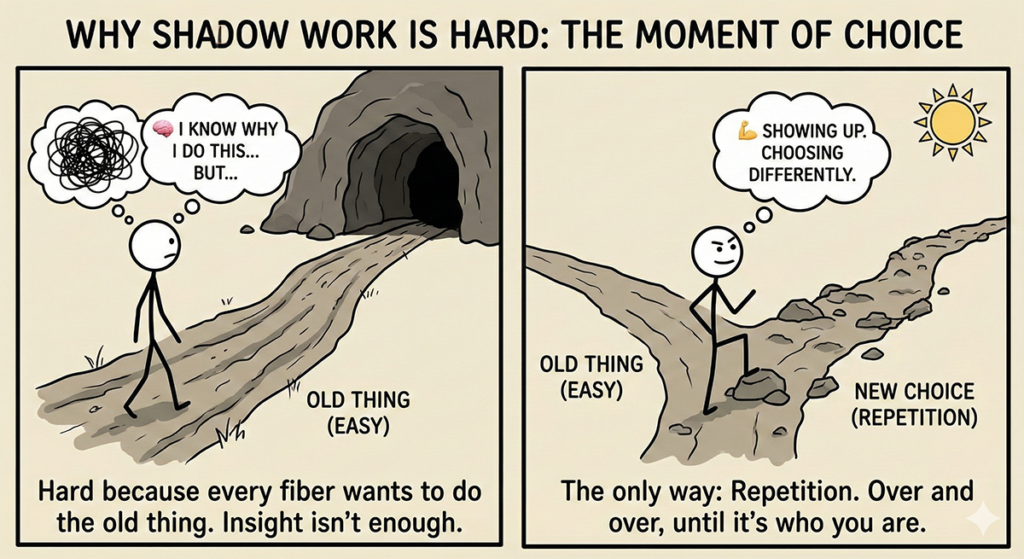
Not insight. Not understanding. Just showing up to the moment and choosing differently.
Over and over.
Until it’s not a choice anymore.
Until it’s just who you are.