Here’s the thing they don’t tell you about journaling:
It can make things worse.
Not because journaling is bad.
But because most people don’t know when to stop.
They start writing to process a feeling.
And three pages later, they’ve spiraled into every bad thing that’s ever happened to them, convinced themselves their life is falling apart, and closed the notebook feeling more anxious than when they started.
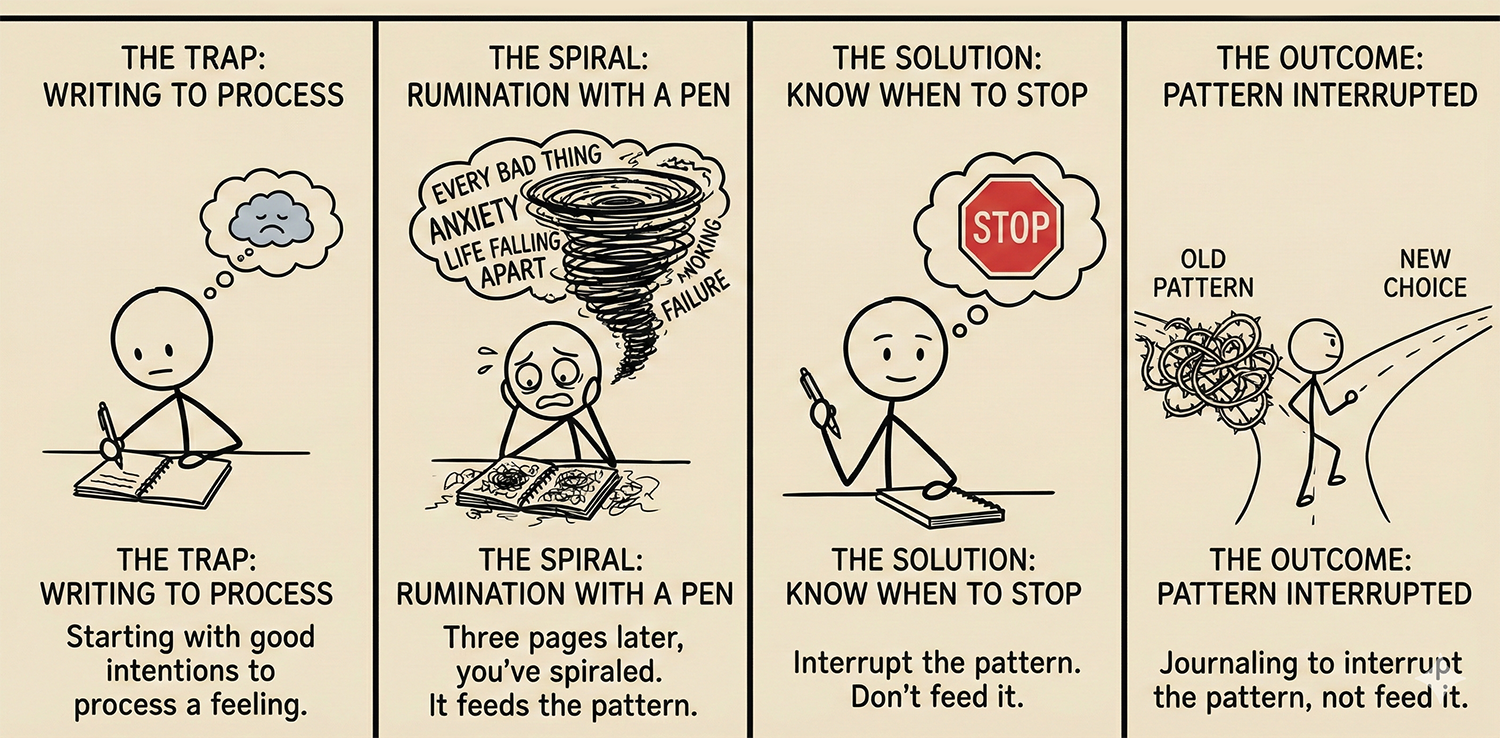
Sound familiar? That’s not shadow work.
That’s rumination with a pen.
And if you want journaling to actually work, you need to know the difference between processing and spiraling.
Because one interrupts the pattern. The other feeds it.
What Journaling for Shadow Work Actually Means
Journaling for shadow work is the act of documenting internal reactions immediately after they occur.
Not to understand them. Not to heal them. To see them.
It’s a practice of observation, not excavation.
You’re not digging into your past. You’re tracking your present.
And the moment you start digging, you’ve left shadow work and entered therapy territory.
Which is fine, if that’s what you need. But it’s not the same thing.
The Problem: Most People Use Journaling to Avoid Feeling
They write about the feeling instead of feeling it.
They analyze it. Explain it. Turn it into a story with a villain and a moral.
And by the time they’re done writing, they’ve successfully bypassed the actual emotion and replaced it with a narrative.
This is why you can journal for years and nothing changes.
Because you’re not processing the reaction.
You’re performing the processing.
And your nervous system knows the difference.
How to Know You’ve Gone Too Far
You’ve crossed the line from shadow work into rumination when:
You’re writing to prove you’re right
If your journal entry is building a case against someone, you’re not doing shadow work.
You’re rehearsing an argument.
Shadow work asks: “What am I defending?”
Rumination answers: “Here’s why I’m justified.”
You’re re-writing the same story
If you’ve written about the same situation three times and you’re still not done, you’re not processing.
You’re looping. And loops don’t resolve. They just wear deeper grooves.
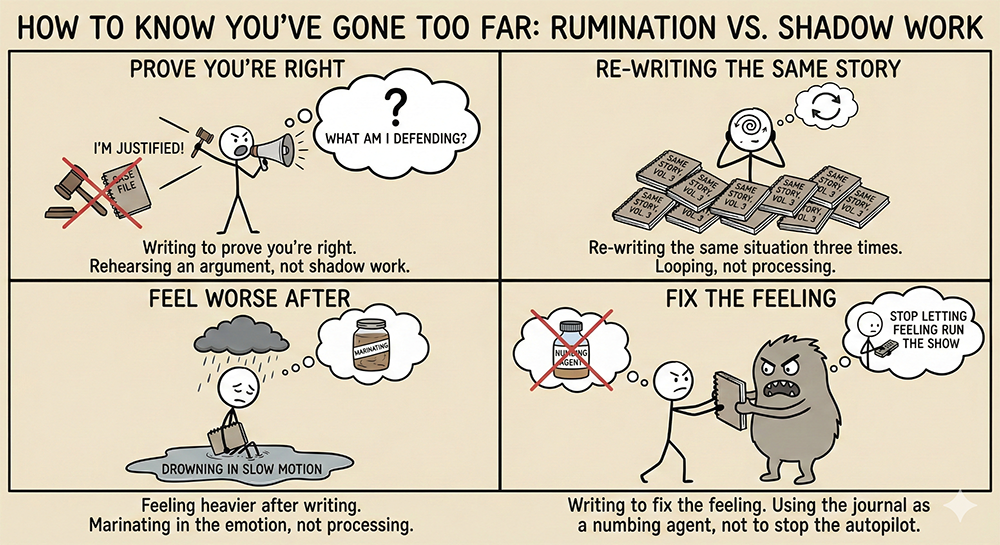
You feel worse after writing
If you close the notebook and feel heavier, you didn’t process the emotion.
You just marinated in it.
Shadow work should feel uncomfortable, but clarifying.
Rumination just feels like drowning in slow motion.
You’re writing to fix the feeling
If your goal is to not feel bad anymore, you’re using the journal as a numbing agent.
Shadow work doesn’t make the feeling go away.
It just makes you stop letting the feeling run the show.
The Boundaries You Need (Even If They Feel Arbitrary)
Time Limit: 5 Minutes Max
If you can’t capture the reaction in five minutes, you’re not documenting, you’re dissertating.
Set a timer.
Write until it goes off.
Then stop.
Even if you’re mid-sentence.
Why this works:
Because the longer you write, the more your brain will justify, explain, and story-tell.
The raw reaction gets buried under layers of narrative.
Five minutes keeps it sharp.
Sentence Limit: 3-5 Sentences
Shadow work entries should be short.
- What happened (the trigger)
- What you did (the reaction)
- What you were defending (the mechanism)
That’s it.
Anything longer and you’re performing.
Example of a clean entry:
“Partner asked if I’d done the thing I said I’d do. I snapped at them. I was defending my reliability because the question made me feel like I wasn’t trusted.”
Done.
No backstory. No justification. No three-page exploration of childhood trust wounds.
Just the moment, the reaction, and the mechanism.
Frequency: Once Per Day (At Most)
Shadow work journaling isn’t a coping mechanism you use every time you feel bad.
It’s a diagnostic tool you use to track patterns.
If you’re journaling multiple times a day, you’re not tracking reactions.
You’re using the journal to regulate your nervous system.
Which, again ,is fine. But, it’s not shadow work.
When to Stop (And What to Do Instead)
Stop if you’re circling the same question
If you’ve asked yourself “Why did they do that?” more than once, you’re ruminating.
Close the journal. The answer doesn’t matter.
What matters is what you did in response.
Stop if you’re writing about the other person more than yourself
Shadow work is about your reactions, not their actions.
If your journal entry is 80% about what they did, you’ve lost the thread.
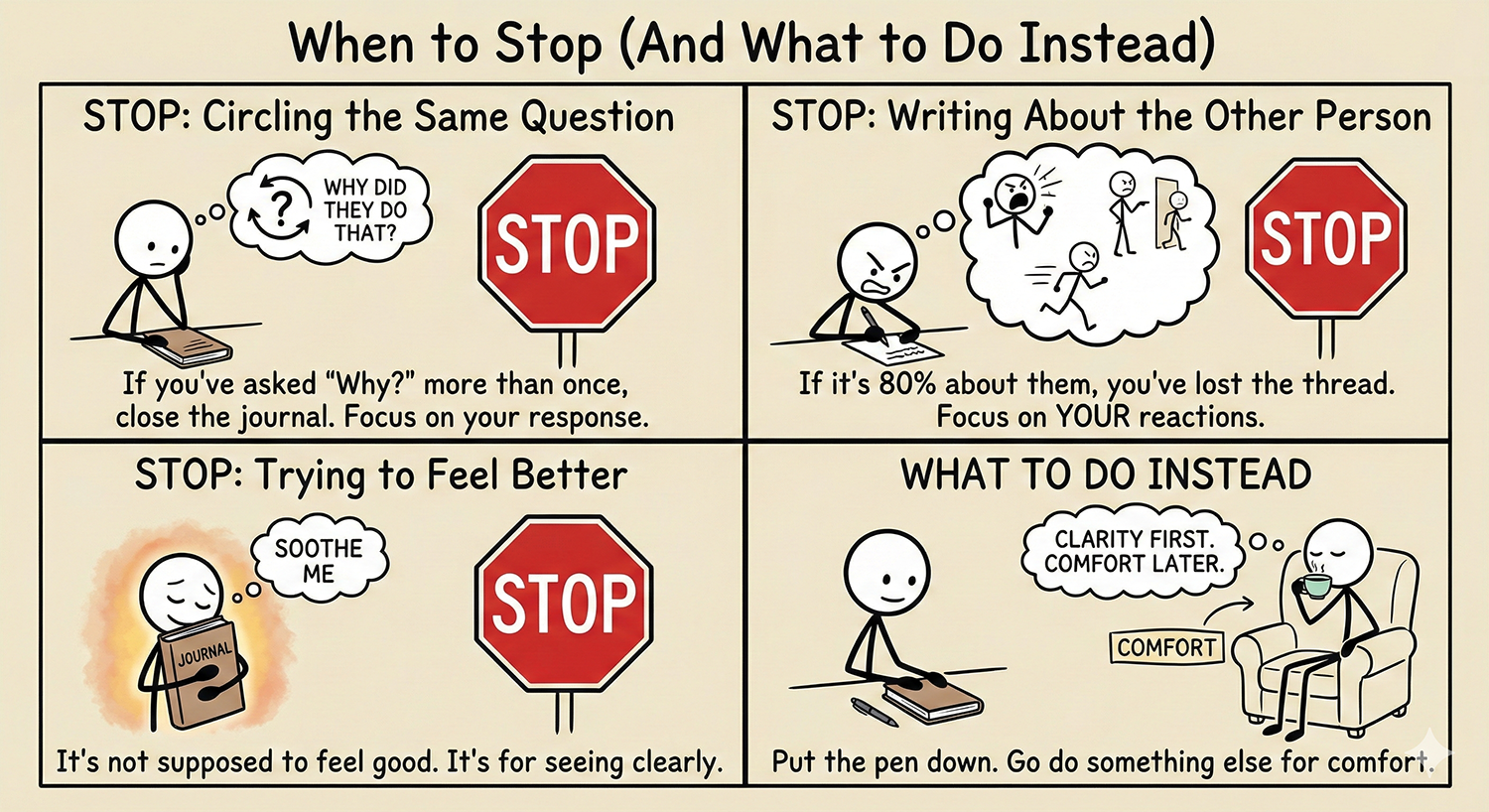
Stop if you’re trying to feel better
Journaling for shadow work isn’t supposed to make you feel good.
It’s supposed to make you see clearly.
If you’re writing to soothe yourself, put the pen down and go do something else.
Comfort has its place.
But shadow work isn’t it.
What to Do When You Hit the Spiral
Because you will.
Even with boundaries, you’ll catch yourself three paragraphs deep into a rant about someone who wronged you in 2017.
When that happens:
1. Stop writing immediately
Don’t finish the thought.
Don’t wrap it up with a tidy conclusion.
Just stop.
2. Close the notebook
Physically. Close it.
Put it somewhere you can’t see it.
3. Move your body
Walk. Stretch. Shake it out.
Your nervous system is activated.
Writing won’t deactivate it.
Movement will.
4. Come back later (or don’t)
If the reaction still feels worth documenting, write one sentence about it later.
If it doesn’t, let it go.
Not everything needs to be processed.
Some things just need to pass.
The Difference Between Healthy Journaling and Toxic Journaling
Healthy Journaling:
- Short entries
- Focused on your reactions, not their actions
- Written immediately after the moment
- Ends when the pattern is visible
Toxic Journaling:
- Pages and pages of explanation
- Building a case against someone
- Written hours (or days) after the moment, when you’ve already edited the story
- Never ends because you’re using it to avoid feeling
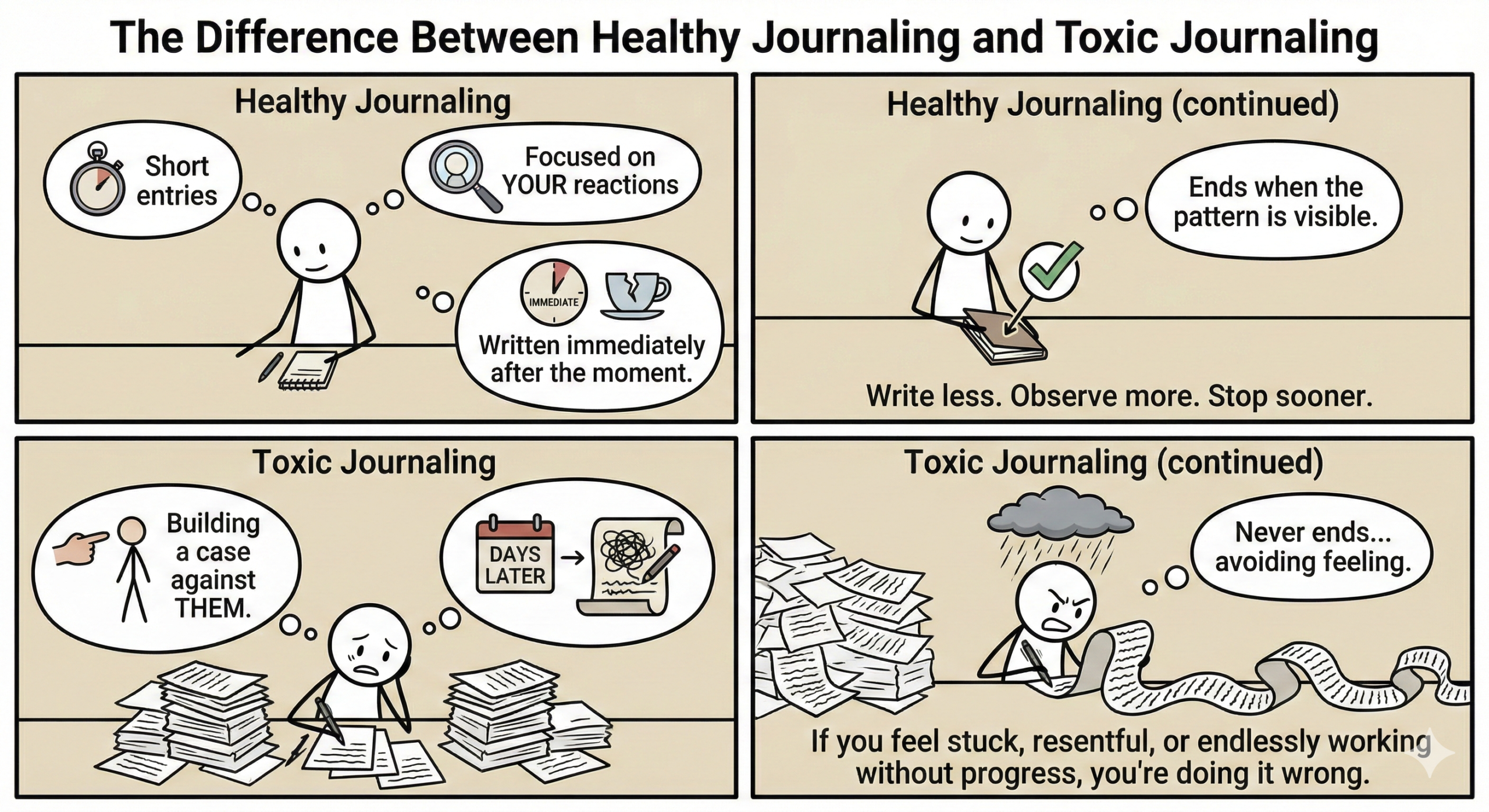
If your journaling practice makes you feel stuck, resentful, or like you’re “working on yourself” endlessly without any progress?
You’re doing it wrong.
And the fix is simple:
Write less. Observe more. Stop sooner.
What Good Journaling Actually Looks Like Over Time
Week 1:
You write about the same reaction three times.
You don’t catch yourself in the moment yet.
But you see the pattern on the page.
Week 4:
You start noticing the early warning signs.
The heat in your chest. The tightness in your throat.
You still react—but you know it’s happening.
Week 8:
You catch yourself mid-reaction once or twice.
You don’t stop it completely.
But you pause long enough to choose a different response.
Week 12:
The reaction still shows up.
But it’s quieter.
And you don’t need to write about it every time—because you already know the pattern.
That’s when the journal stops being a daily practice and becomes a reference tool.
You check in when the pattern shifts.
But most of the time?
You’re just living.
And the autopilot isn’t running the show anymore.
The Part No One Warns You About
Journaling for shadow work doesn’t make you feel better.
It makes you see better.
And sometimes, seeing clearly is uncomfortable.
You realize:
- How often you make things about you that aren’t
- How much you defend things that don’t need defending
- How quickly you assume the worst because it feels safer than hoping
And that’s hard. But it’s also the only way forward.
Because you can’t interrupt a pattern you refuse to see.
And the journal, when used correctly ,this makes the pattern impossible to ignore.
Where to Go From Here
If you want the full system—the one that makes shadow work automatic instead of exhausting—start here:
Get the system that makes this effortless
Or if you want to go deeper into the what of shadow work journaling:
- The Shadow Work Journal: What It Is and Why It Works
- Shadow Work Questions That Cut Straight Through the Noise
Because here’s the truth:
The journal isn’t magic.
It’s just a mirror.
And the more you look in it, the harder it becomes to pretend you don’t see yourself doing the thing.
That’s when the change starts.
Not because you wanted it.
Because you couldn’t unsee it anymore.
And once you see it clearly enough, the pattern starts to crack.
Write less.
See more.
Stop sooner.
That’s the whole game.