You’ve probably heard a lot of questions designed to make you “go deeper.”
Questions about your inner child.
Questions about what you need to release.
Questions that feel profound but somehow never change what you do on a Tuesday afternoon when someone questions your competence.
Here’s why:
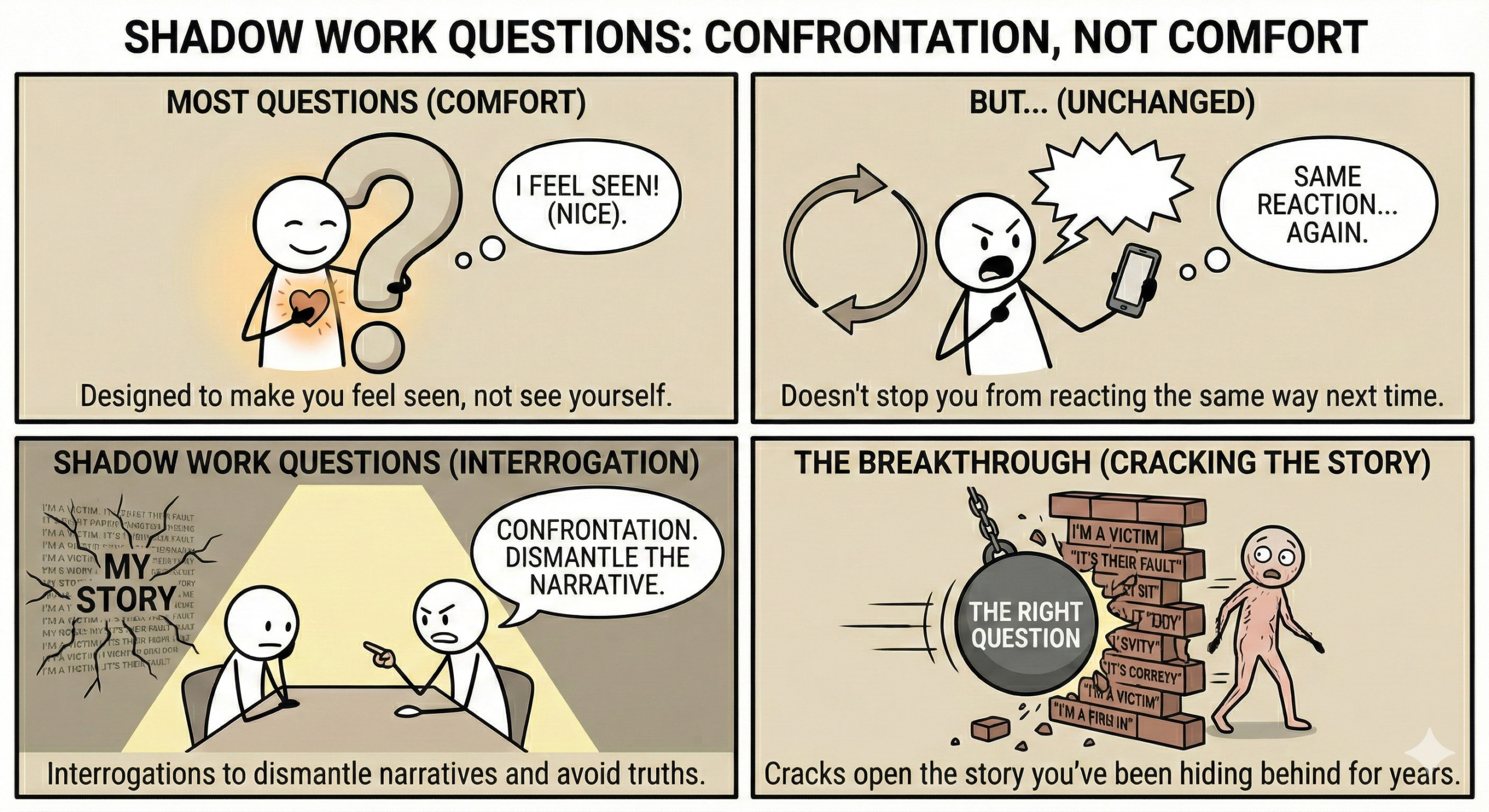
Most shadow work questions are designed to make you feel seen, not to make you see yourself.
And feeling seen is nice.
But it doesn’t stop you from reacting the same way next time.
Shadow work questions are interrogations designed to dismantle the narratives you tell yourself to avoid admitting uncomfortable truths.
They’re not therapy.
They’re confrontation.
And the right question, asked at the right moment, can crack open a story you’ve been hiding behind for years.
Why One Question Can Ruin Your Favorite Excuse
Because your brain is very good at building cases.
It will create entire justifications for why you’re upset, why you reacted, why you’re entitled to feel this way.
And most of those justifications are bullshit.
They’re just elaborate ways of avoiding the thing you don’t want to admit:
- That you made it about you when it wasn’t
- That you assumed the worst because hoping felt too risky
- That you’re defending a version of yourself that doesn’t even exist anymore
The right question doesn’t let you hide behind the justification.
It forces you to look at the mechanism underneath.
And once you see the mechanism, the excuse stops working.
The Questions (Use Them When You’re Ready to Stop Lying)
These aren’t conversation starters. They’re pattern breakers.
Use them when you’re mid-story, mid-justification, or mid-defense and you know, deep down, that you’re performing instead of being honest.
What am I making this mean that it doesn’t actually mean?
This question stops the spiral before it starts.
Because most of the time, the thing that triggered you wasn’t even about you.
But you made it about you anyway.
And then you reacted to the story you created, not the thing that actually happened.
What would I have to give up to admit I’m wrong here?
This one cuts deep.
Because sometimes being wrong means losing your position, your narrative, or your identity as “the person who knows better.”
And that feels like death. But it’s just ego.
And ego will burn every relationship to the ground if it means staying intact.
What part of me just tried to control the outcome and what’s the fear underneath that need?
Control is just fear pretending to be competence.
This question exposes the fear so you stop mistaking the controlling behavior for strength.
What am I defending that I don’t actually believe?
This one is brutal.
Because sometimes you’re not defending the truth.
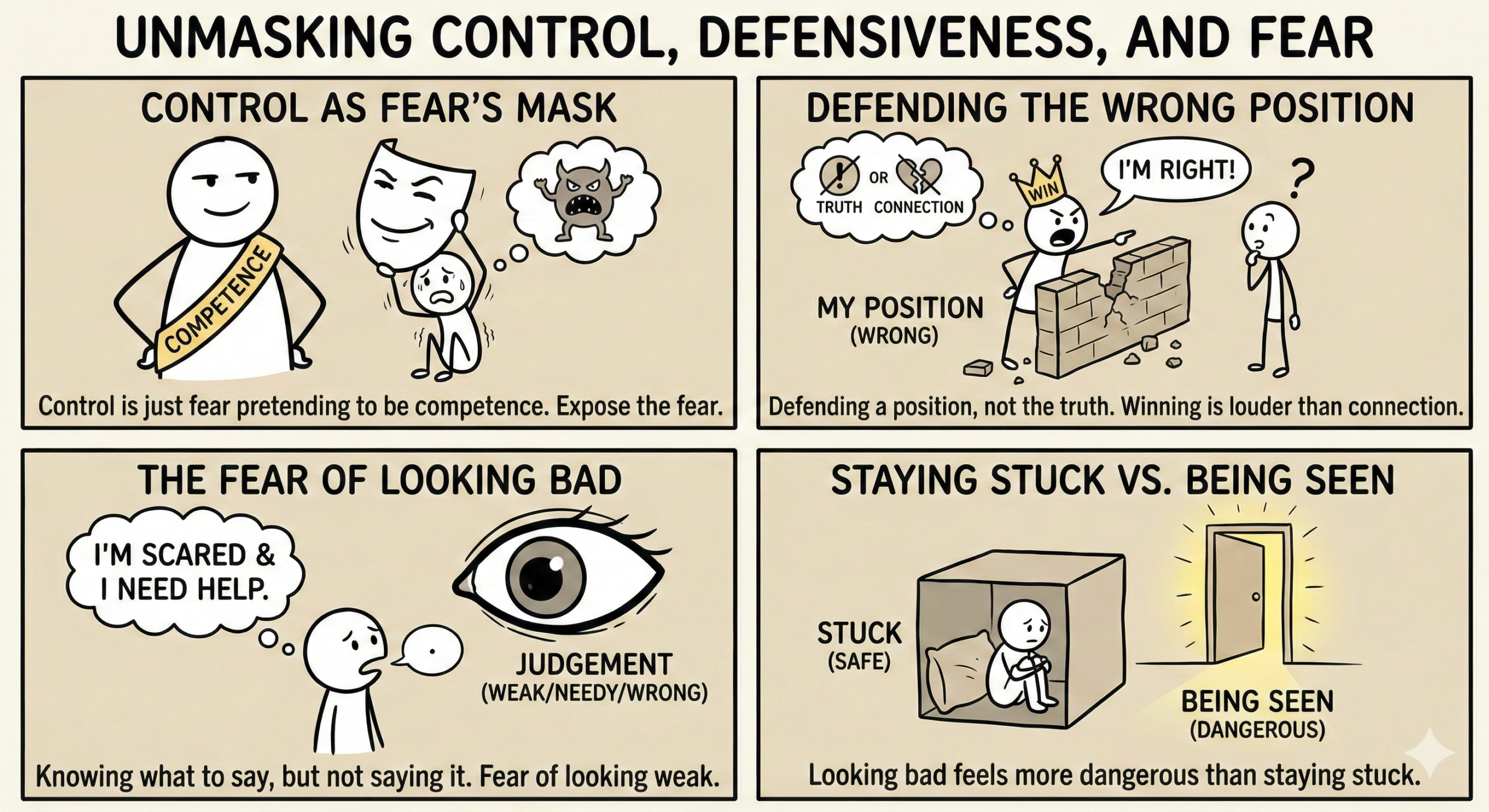
You’re defending your position. Even when you know you’re wrong.
Even when you’d rather be connected than right. But the need to win is louder than the need to be close.
If I wasn’t afraid of how it would make me look, what would I actually say right now?
Most of the time, you know what needs to be said.
You just don’t say it.
Because saying it might make you look weak, needy, or wrong.
And looking like that feels more dangerous than staying stuck.
What story am I telling myself to avoid feeling what I’m actually feeling?
Your brain loves a good story.
It will create an entire narrative just to avoid the raw, unprocessed emotion underneath.
Because emotions are messy. Stories are tidy.
But the story is usually a distraction from the feeling.
What would I do differently if I wasn’t trying to prove something?
Most reactions aren’t about the moment.
They’re about proving you were right all along.
Proving you’re competent. Proving you’re worth listening to.
Proving you’re not the person someone once made you feel like.
But the need to prove is the shadow talking.
What do I need them to do that would make me feel okay and why is that their job?
This one is uncomfortable.
Because it reveals how much you’re outsourcing your sense of safety to someone else’s behavior.
And once you see that, you can’t unsee it.
What part of this is actually about them and what part is about something much older?
Most triggers aren’t about the present moment.
They’re about the past moment that taught you this is how things go.
This question helps you separate the two.
If I let this go without making them understand, what would I lose?
Usually, the answer is: nothing. But it feels like everything.
Because letting go without “winning” feels like abandoning yourself.
But sometimes, letting go is the win.
What would I need to believe about myself to not need their validation?
Validation-seeking isn’t connection.
It’s outsourcing your self-worth.
This question brings it back home.
What am I not saying because I’m afraid of conflict and what’s it costing me?
Avoiding conflict doesn’t keep you safe.
It just makes you smaller. This question shows you the price of peace-at-all-costs.
What’s the thing I keep doing that I’d call out in someone else?
This one stings.
Because it’s easy to see other people’s patterns.
It’s much harder to admit you’re running the same loop.
If this reaction were a defense mechanism, what would it be defending?
Because it is.
And it is defending something.
The question is: what?
And is it still worth defending?
What would change if I stopped making this about my worth?
Most reactions are just worth-protection wearing a disguise.
This question strips the disguise off.
How to Use These (Without Turning It Into Self-Interrogation Theater)
Don’t answer all of them.
Don’t print them out and put them on your wall.
Don’t make this into a self-help hobby.
Here’s what works:
Pick one question.
The one that makes your stomach tighten when you read it.
Ask it once.
Answer it in one sentence.
Then move on.
You don’t need to journal about it for three pages.
You don’t need to “process” it.
You just needed to see it.
And once you see it, the pattern starts to crack.
What Makes These Questions Different
They don’t comfort you. They don’t validate you.
They don’t let you off the hook with a pretty insight. They corner you.
And they force you to look at the thing you’ve been avoiding:
- The part of you that’s still defending something that doesn’t need defending
- The story you’ve been telling yourself to avoid admitting you’re wrong
- The need for control that’s actually just fear in a power suit
These questions don’t make you feel better.
They make you see better.
And seeing clearly is the only way forward.
Why This Works (Even When It Feels Pointless)
Because you can’t sidestep a question.
You can sidestep a conversation. You can sidestep a journal entry.
But when a question hits the exact nerve you’ve been protecting?
Your first instinct is to deflect. And that deflection is the tell.
The question you resist the most is the one you need to answer.
Not because it’s “healing.”
Because it’s exposing the mechanism you’ve been running on autopilot.
And once you see the mechanism, it loses its power.
What Happens When You Actually Do This
You stop being able to lie to yourself as easily.
The stories you tell to justify your reactions start to sound hollow.
The defenses you’ve built start to feel like prisons instead of protection.
And slowly, painfully, you start choosing differently. Not because you’ve healed.
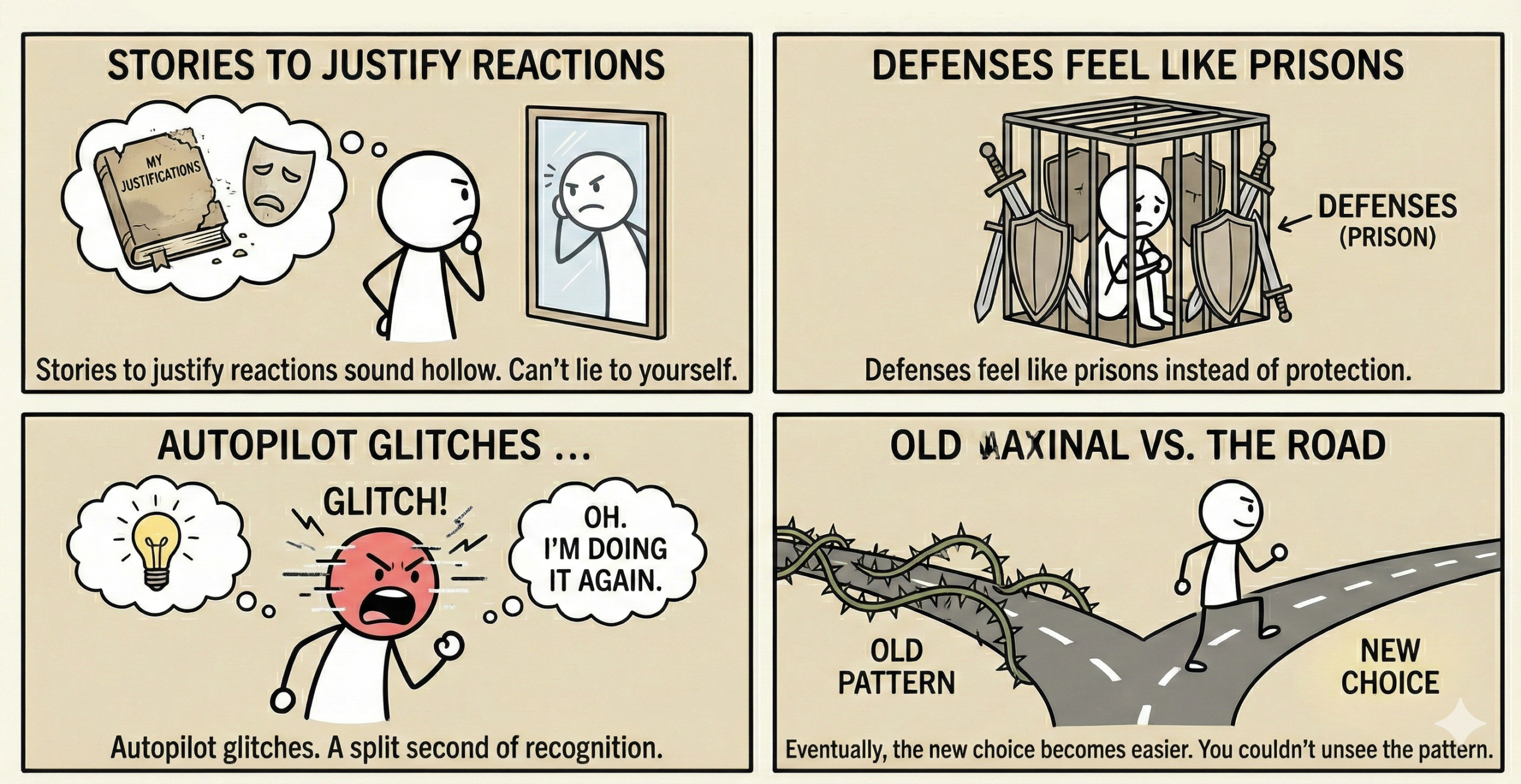
Because you’ve seen yourself do the thing enough times that the autopilot starts to glitch.
The reaction still wants to happen.
But now there’s a split second of recognition:
“Oh. I’m doing it again.”
And in that split second, you have a choice.
Most of the time, you’ll still choose the old pattern. But eventually, the new choice becomes easier.
Not because you wanted it to. Because you couldn’t unsee the pattern anymore.
The Part That Makes People Uncomfortable
These questions don’t make you nicer.
They don’t make you more “healed.”
They make you more honest.
And honesty, real honesty, pisses people off.
Because when you stop pretending, you stop accommodating.
You stop over-explaining.
You stop apologizing for things that aren’t your fault.
And people who were comfortable with the old version of you?
They’re going to notice.
They might even accuse you of “changing” or “being harsh.”
That’s not you doing shadow work wrong.
That’s you stopping the people-pleasing autopilot.
And yes, it’s uncomfortable.
But so is spending the rest of your life letting your nervous system make decisions for you.
Where to Go From Here
If you want the full system—the one that makes shadow work automatic instead of aspirational—start here:
Get the system that makes this stick
Or if you want to keep going deeper:
- Shadow Work Prompts That Don’t Waste Your Time
- How to Do Shadow Work Without Turning It Into a Personality Project
Because here’s the truth:
The right question, asked at the right time, can dismantle a story you’ve been telling yourself for years.
But only if you’re willing to hear the answer.
And only if you’re willing to stop letting the story run your life.
The questions are here.
The hard part is admitting you already know the answers.