Nervous System Stuck in Fight or Flight: Why It Happens (And How to Bring It Back to Baseline)
If your body feels like it’s bracing for impact ,even on ordinary days, something is still switched on.
You might notice:
- You can’t relax, even on vacation
- Your mind scans for problems automatically
- You’re exhausted but wired
- Small stressors feel disproportionate
- You stay alert, rarely settled
This isn’t by accident.
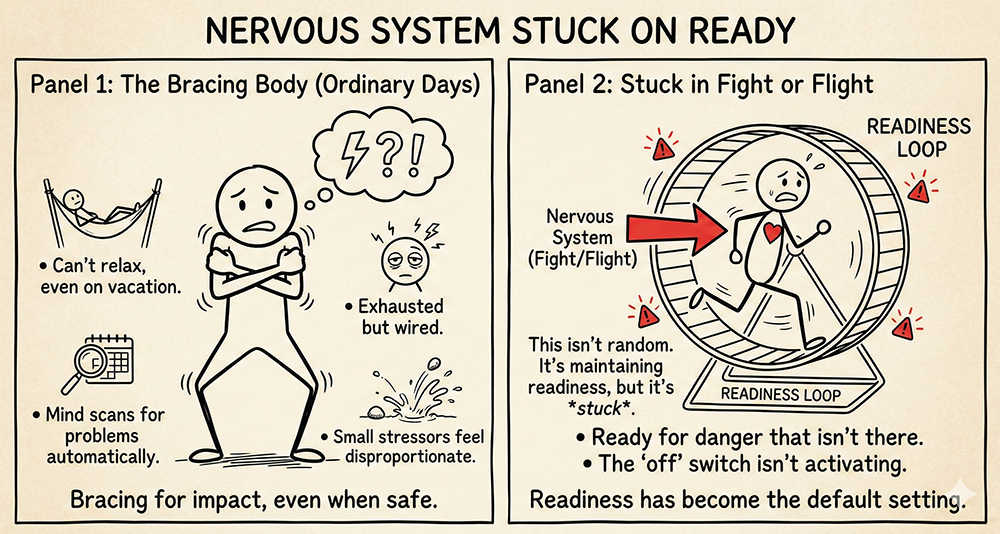
Your nervous system is stuck in Fight or Flight as the main way of maintaining readiness.
Let’s examine why.
What “Fight or Flight” Actually Is
Fight or flight is a survival response governed by the autonomic nervous system.
When the brain registers threat whether that is physical, emotional, or social, it initiates:
- Increased heart rate
- Faster breathing
- Muscle tension
- Heightened attention
- Stress hormone release
This response is efficient when escaping danger.
It becomes inefficient when the perceived “threat” is an email, a shift in tone, financial uncertainty, or a memory.
The nervous system reacts to perceived threat.
It does not require objective danger.
Why It Doesn’t Power Down
Short activation cycles are healthy.
Chronic activation alters baseline.
Over time, the body adapts to tension as its normal operating state.
Common reasons this happens:
1. Stress Without Recovery
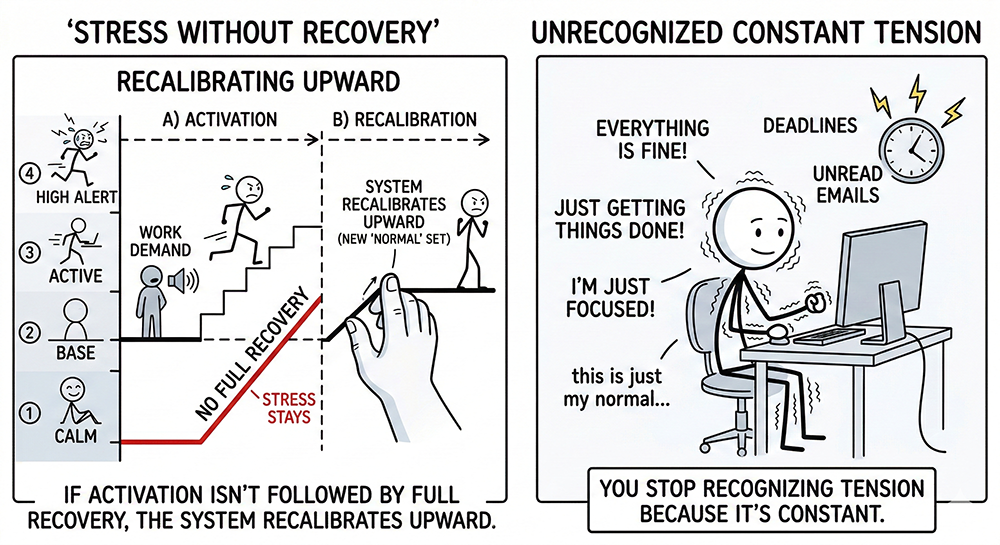
If activation isn’t followed by full recovery, the system recalibrates upward.
You stop recognizing tension because it’s constant.
2. Early Unpredictability
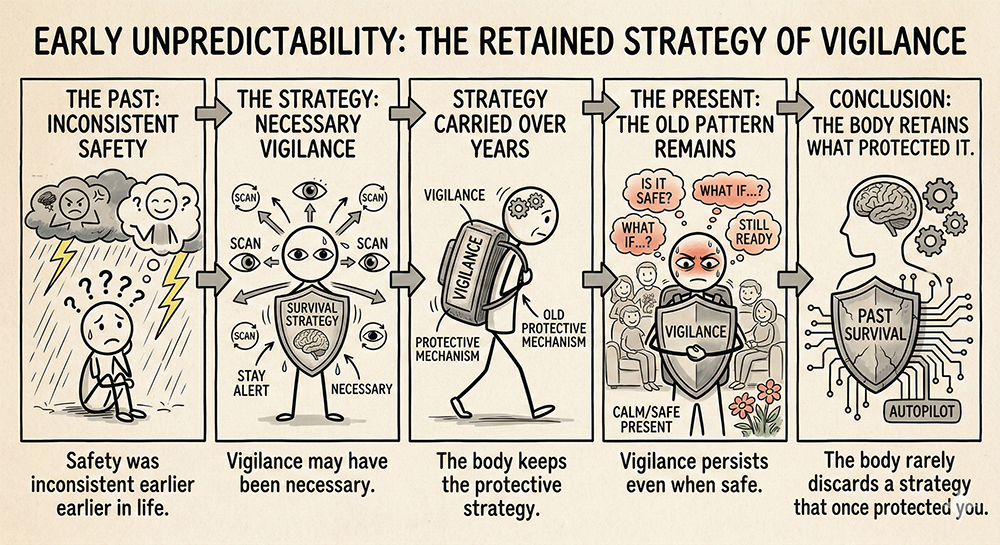
If safety was inconsistent earlier in life, vigilance may have been necessary.
The body rarely discards a strategy that once protected you.
3. Intense Emotional Events
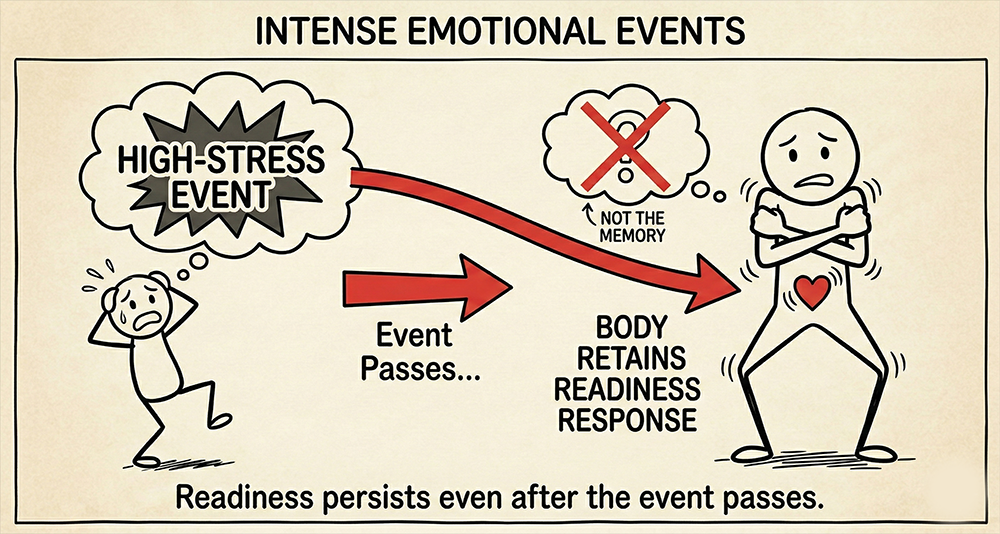
When high-stress experiences aren’t processed, the body retains the readiness response — even after the event has passed.
Not the memory.
The readiness.
4. Identity-Level Adaptation
Over time, activation stops feeling like a state and starts feeling like personality.
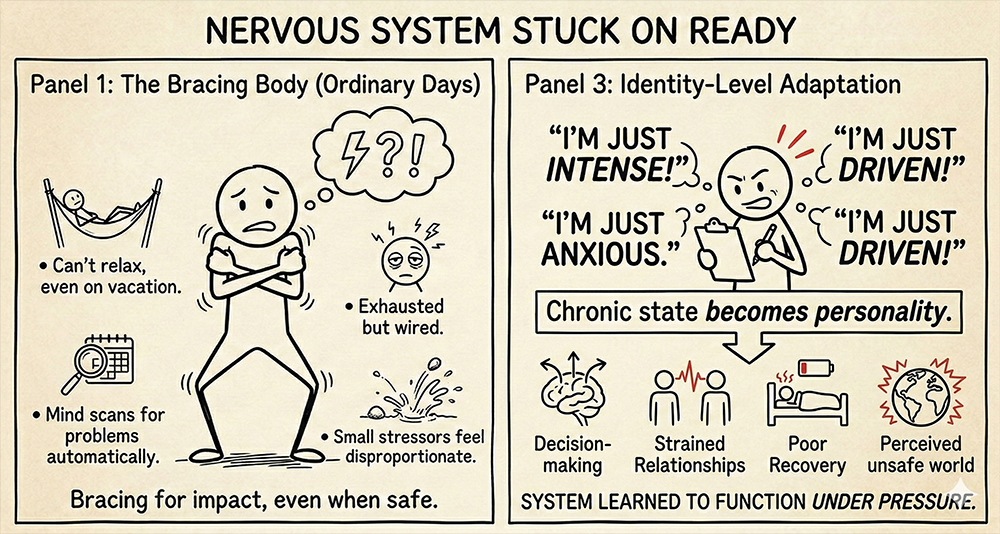
“I’m just intense.”
“I’m just anxious.”
“I’m just driven.”
More precisely: your system learned to function under pressure.
When this becomes chronic, it doesn’t just increase stress.
It affects decision-making, relationships, recovery, and how safe the world feels overall.
Signs You’re Chronically Activated
- Overthinking simple decisions
- Irritability or rapid defensiveness
- Sleep that never restores
- Digestive tightness
- Restlessness without direction
- Productivity driven by pressure rather than intention
- Feeling unsafe even when circumstances are stable
It resembles a smoke alarm calibrated too sensitively.
Nothing is burning.
But it continues to signal.
Why Quick Fixes Only Go So Far
Breathing exercises help.
Cold exposure helps.
Meditation helps.
They reduce physiological intensity.
But if the system continues to interpret certain situations as unsafe, activation will return.
Regulation lowers arousal.
It does not automatically revise the underlying rule generating the response.
That requires a different layer of work.
What’s Actually Being Protected
Persistent activation is usually guarding something.
A belief.
An expectation.
A learned rule.
Common internal instructions sound like:
- “If I relax, I’ll lose control.”
- “If I’m not alert, I’ll fall behind.”
- “If I don’t stay prepared, something will go wrong.”
The body isn’t malfunctioning.
It is following directives formed under earlier conditions.
Those directives may no longer match your current environment.
How to Move Back Toward Baseline
There are three practical layers.
Layer 1: Immediate Regulation
- Extend the exhale slightly longer than the inhale
- Use low-intensity movement to discharge tension
- Reduce overstimulation (constant notifications, media saturation)
- Maintain consistent sleep timing
These reduce acute activation.
They are necessary.
They are not complete.
Layer 2: Sequence Awareness
With the Nervous System Stuck in Fight or Flight, activation follows a sequence.
Notice:
- What situation precedes it?
- What thought appears first?
- What outcome are you trying to prevent?
- What feels at risk?
Without identifying the sequence, the response repeats automatically.
Layer 3: Response Revision
If your nervous system learned a strategy under pressure, the goal isn’t suppression.
It’s revision.
That requires:
- Identifying the trigger
- Tracing when this reaction first made sense
- Clarifying what it was designed to protect
- Choosing a different action at the moment activation begins
This interrupts the automatic execution cycle.
By updating the instruction set the system is operating on.
Managing Stress vs Updating the System
Coping strategies reduce intensity.
If activation keeps returning, the governing rule remains intact.
Long-term change requires:
- Understanding the response
- Identifying the internal rule behind it
- Becoming aware at the first moment of escalation
- Practicing an alternative action consistently
That is revision, not suppression.
If You Want to Actually Change This
When your Nervous System Stuck in Fight or Flight, starts to run the show, you already know temporary relief isn’t enough.
Breathing helps.
Reducing stimulation helps.
Better sleep helps.
But if the activation keeps returning, there is usually a repeatable internal sequence driving it:
A trigger.
A thought.
An old rule.
An automatic reaction.
You can’t revise what you haven’t mapped.
The difference between managing stress and changing it is structure.
The Shadow Work System is a structured process for identifying and revising the internal rules behind automatic emotional reactions.
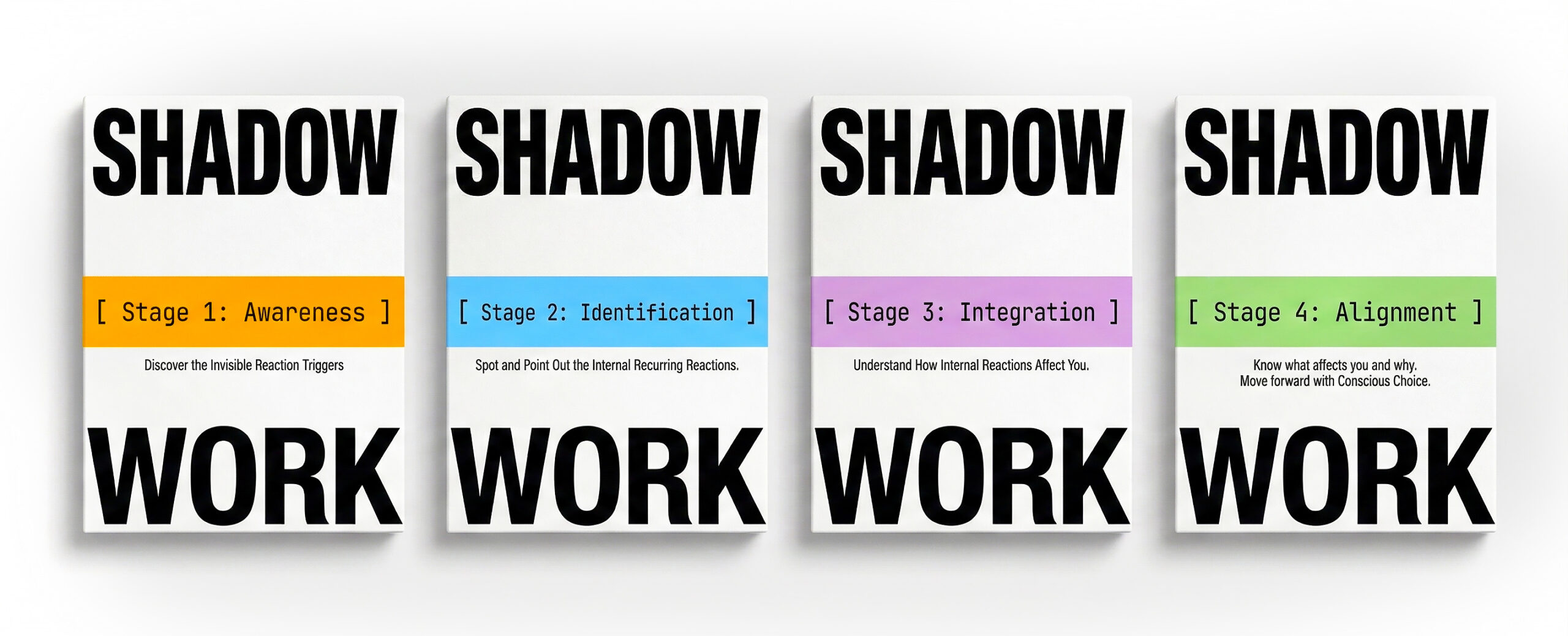
It helps you:
- Identify the reaction sequence in real time
- Trace when the response first made sense
- Understand what it was designed to protect
- Replace the automatic response with a deliberate one
It isn’t therapy.
It isn’t motivational content.
It’s a practical framework for moving from reaction to choice.
If your nervous system feels stuck in survival mode, the goal isn’t to calm it forever.
The goal is to update the instruction set it’s operating on.
If you’re ready to stop managing activation and start revising it, the Shadow Work System is built for that purpose.
Can your nervous system get stuck in fight or flight?
Yes. If stress is prolonged or unresolved, the nervous system can remain in a heightened state of activation. Over time, this elevated state can become the new baseline, making it difficult to relax even when there is no immediate danger.
What causes chronic fight or flight?
Chronic fight or flight is usually caused by repeated stress without recovery, early life unpredictability, unresolved emotional events, or persistent perceived threats. The nervous system adapts to what it experiences most often. If activation is frequent, it becomes familiar.
How do I reset my nervous system from fight or flight?
Short-term regulation techniques such as slow breathing, gentle movement, and reducing overstimulation can lower activation. Long-term change requires identifying the triggers and internal rules that keep the response active and deliberately revising them.
How long does it take to calm an overactive nervous system?
Immediate calming techniques can reduce activation within minutes. However, shifting a chronically elevated baseline may take consistent practice over weeks or months, especially if the response has been reinforced for years.
Is being stuck in fight or flight the same as anxiety?
Not exactly. Anxiety is a psychological experience, while fight or flight is a physiological survival response. They often overlap, but the nervous system can be activated even without conscious anxiety.