Fight, Flight, Freeze, Fawn, and Flop: The 5 Trauma Responses Explained (And How They Shape Behavior)
Most people think trauma responses only activate during extreme danger.
They don’t.
They activate whenever the nervous system detects threat physical, emotional, or social.
Over time, these responses don’t just show up in stressful moments.
- They influence decisions.
- They affect relationships.
- They quietly guide behavior.
The five primary trauma responses are:
- Fight
- Flight
- Freeze
- Fawn
- Flop
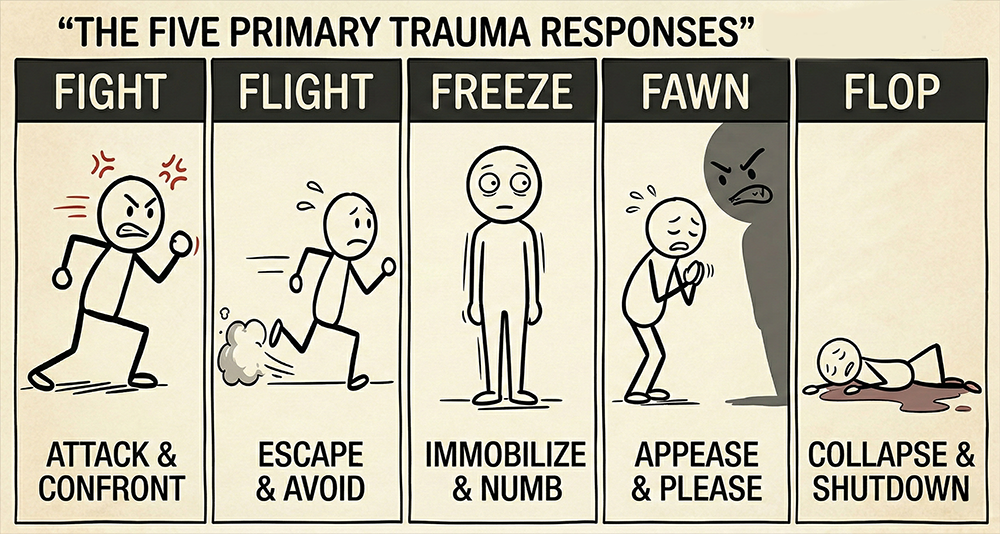
Understanding them changes how you interpret yourself and other people.
What the 5 Trauma Responses Actually Are
Trauma responses are automatic survival strategies governed by the autonomic nervous system.
When something feels threatening, the body selects a strategy:
- Confront
- Escape
- Immobilize
- Appease
- Shut down.
These are not personality traits.
They are responses selected under pressure.
The problem isn’t that they exist.
The problem is when they continue running long after the original threat is gone.
1. Fight
Fight mobilizes energy outward.
It can look like:
- Irritability
- Defensiveness
- Anger
- Control behaviors
- Intensity under stress.
At its core, fight says:
“If I increase force, I regain safety.”
In adulthood, this might show up as:
Arguing quickly
Over-controlling environments
Harsh self-criticism
Difficulty backing down
Fight is protection through dominance.
2. Flight
Flight mobilizes energy toward escape or achievement.
It can look like:
- Overworking
- Overplanning
- Restlessness
- Perfectionism
- Productivity driven by pressure.
The underlying message:
“If I stay ahead, I stay safe.”
Flight often hides inside ambition.
It is protection through movement.
3. Freeze
- Freeze is immobilization.
- It can look like:
- Procrastination
- Indecision
- Mental fog
- Avoidance
- Feeling stuck.
Freeze says:
“If I don’t move, I won’t make it worse.”
It is protection through stillness.
4. Fawn
Fawn prioritizes relational safety.
It can look like:
- People-pleasing
- Over-apologizing
- Difficulty setting boundaries
- Prioritizing others at your own expense
The internal rule:
“If I stay liked, I stay safe.”
It is protection through appeasement.
4. Flop
Flop is shutdown.
It resembles:
- Emotional Numbness.
- Disconnection.
- Collapse after stress.
- Giving up quickly.
- Dissociation.
Flop says:
“If I powered down, I reduce damage.”
It is protection through withdrawal.
How These Responses Start Shaping Identity
When one of these responses activates repeatedly, it becomes familiar.
When it becomes familiar, it starts feeling like identity.
You stop saying: “My nervous system is activating.”
You start saying: “That’s just how I am.”
Fight becomes “strong personality.”
Flight becomes “driven.”
Freeze becomes “lazy.”
Fawn becomes “nice.”
Flop becomes “low energy.”
But these are strategies learned under pressure.
And strategies can be updated when they’re no longer useful.
Why This Distinction Matters
If you mislabel a trauma response as personality, you try to change it with willpower.
That rarely works.
If you recognize it as a survival strategy, you can examine:
- When it activates
- What it is trying to protect
- Whether it still fits your current life
Understanding this removes unnecessary self-blame.
But understanding alone does not change behavior.
Managing vs Updating the Response
You can manage fight with breathing.
You can manage flight with stricter scheduling.
You can manage freeze with motivation tactics.
You can manage fawn with boundary scripts.
You can manage flop with stimulation.
But if the internal rule driving the response remains intact, the sequence repeats.
- You calm it down.
- Then it reactivates.
Because the rule hasn’t changed.
he response only shifts when the internal rule behind it is examined and updated.
When These Responses Stay Unexamined
When these survival strategies continue running automatically, they don’t disappear.
They repeat:
- In conversations.
- In relationships.
- In self-talk.
- In high-stakes moments.
You might notice:
- The same argument pattern
- The same stress cycle
- The same collapse after pressure
- The same overdrive when you feel uncertain
If you’ve been trying to “fix” yourself for years and nothing sticks, this may be why.
Insight without structure rarely leads to behavioral revision.
From Recognition to Deliberate Change
Understanding your dominant trauma response is the first step.
Mapping the trigger-to-reaction sequence is the next.
Then comes identifying the internal rule that made that response necessary in the first place.
Most people stop at recognition.
- They learn the model.
- They recognize themselves in it.
But their reactions remain the same because the activation sequence was never broken down step by step.
Lasting change requires more than awareness.
It requires deliberate examination and structured revision of the response.
If You Recognize Yourself Here
If one of these responses feels familiar, that’s not a diagnosis.
It’s information.
Your nervous system selected a strategy under pressure.
The important question isn’t:
“Why am I like this?”
It’s:
“Does this strategy still serve the life I’m living now?”
If you’re ready to move beyond labeling your behavior and begin updating it methodically, structured self-observation is where that work begins.
Understanding the response explains your past.
Revising the rule behind it changes your future behavior.
FAQ
Are trauma responses the same as personality traits?
No.
Personality traits are relatively stable preferences.
Trauma responses are automatic survival strategies.
The confusion happens when a response activates repeatedly over time. It becomes familiar, and familiarity starts to feel like identity.
If someone has relied on fight for years, they may think they’re simply “strong-willed.” If someone defaults to flight, they may think they’re “just driven.”
But these behaviors often originate as protection, not personality.
The important distinction is this:
Traits are preferences.
Trauma responses are protective reactions.
Protective reactions can be examined and updated.
Can you have more than one trauma response?
Yes.
Most people don’t operate from just one.
You may:
Use fight at work
Use fawn in relationships
Use freeze under financial pressure
Your nervous system selects whichever strategy feels most effective in the moment.
Structured self-observation helps identify which response activates in which context, rather than assuming you “are” one type.
What causes trauma responses to develop?
Trauma responses develop when the nervous system learns that a certain strategy increases safety under pressure.
This can happen due to:
Chronic stress
Emotional unpredictability
High expectations
Social rejection
Intense experiences that weren’t processed
The body doesn’t evaluate morality.
It evaluates survival.
If a strategy works once, it stores it.
Do trauma responses ever go away on their own?
They can soften when stress decreases.
But if the internal rule behind the response remains intact, it often reactivates under pressure.
For example:
If someone learned, “If I don’t stay ahead, I lose control,” flight may return during uncertainty even if life is stable.
Responses change when the rule driving them is examined and updated ,not just when circumstances improve.
How do I know which trauma response is dominant for me?
Start by observing:
What do I do first under stress?
Do I move toward, away from, shut down, appease, or power off?
What am I trying to prevent in that moment?
Patterns emerge over time.
Mapping the trigger-to-reaction sequence step by step makes this clearer than guessing based on surface behavior.
Is recognizing my trauma response enough to change it?
Recognition explains behavior.
It doesn’t automatically revise it.
Many people understand their tendencies intellectually but continue repeating them because the activation sequence was never examined in detail.
Change requires:
Identifying the trigger
Tracing when the response first made sense
Recognizing what it protects
Practicing a different action deliberately
Without structure, insight stays conceptual.
With structure, it becomes actionable.
Are trauma responses a sign that something is wrong with me?
No.
They are signs that your nervous system adapted under pressure.
The question isn’t whether the response was valid at the time.
The question is whether it still fits your current life.
Self-blame doesn’t change the response.
Understanding and structured revision do.
Can trauma responses affect relationships?
Yes.
Unexamined responses often show up in:
Conflict patterns
Communication breakdowns
Withdrawal during stress
Over-accommodation
Escalation cycles
When both people understand the underlying survival strategy at play, interactions become easier to navigate.
Without that understanding, the same cycles repeat.
What’s the difference between managing a trauma response and updating it?
Managing focuses on calming the body in the moment.
Updating focuses on revising the internal rule driving the response.
Both matter.
But if the internal rule remains untouched, the response will likely return under pressure.
Long-term behavioral change happens when the response is examined methodically rather than suppressed.
Where do I start if I want to work on this?
Begin with observation.
Notice:
The first physical signal
The first thought
The first impulse
Then ask:
What am I trying to prevent?
What feels at risk?
From there, a structured process makes it easier to trace, examine, and deliberately revise the response instead of reacting automatically.
That’s where systematic self-observation becomes useful.