Shadow Work Journal Prompts for When Writing Finally Clicks
There are two kinds of journaling.
The kind where you write three pages about your feelings and then close the notebook feeling worse.
And the kind where you write two sentences and suddenly the thing that’s been eating you alive loses its teeth.
Most people never find the second kind.
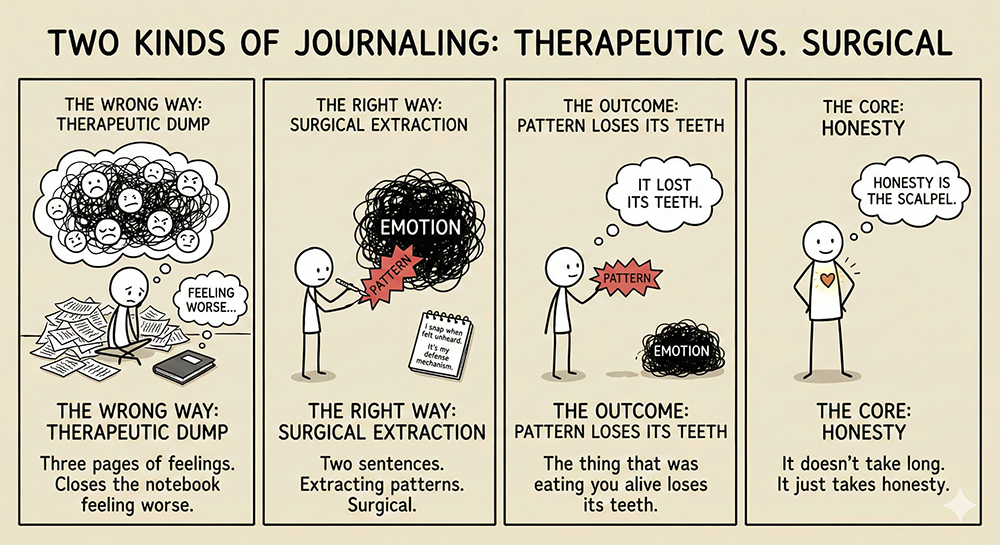
Because they think journaling is supposed to be therapeutic, exploratory, and open-ended.
It’s not. Real shadow work journaling is surgical. You’re not dumping thoughts.
You’re extracting patterns.
And when you do it right? It doesn’t take long. It just takes honesty.
Why Most Journal Prompts Feel Like Busywork
Because they are.
They’re designed to keep you writing, not changing.
“How do I feel about this?”
“What came up for me today?”
“What am I grateful for?”
These prompts are fine if you want to document your emotional weather.
But if you want to stop repeating the same reaction every time someone questions you?
You need prompts that force you to look at the mechanism, not the mood.
The Difference Between Writing to Express vs. Writing to Intercept
Writing to express: “I’m so angry at them for not listening to me.”
Writing to intercept: “What did I need them to do that would have made me feel seen? And why is that their job?”
See the difference?
One lets you vent.
The other makes you own your part.
Shadow work journal prompts are questions designed to expose the unconscious patterns driving your reactions—so you can interrupt them before they run the show.
Not to make you feel better.
To make you see better.
How to Know When Journaling Is Actually Working
You know it’s working when:
- You write something and immediately want to stop writing
- You have a realization that makes you uncomfortable
- You catch yourself mid-excuse and call yourself out in the same sentence
- You close the notebook feeling exposed instead of validated
If journaling makes you feel cozy and understood, you’re doing therapy lite.
If it makes you squirm a little?
You’re doing shadow work.
The Prompts (Organized by Trigger Type)
CONFLICT PROMPTS
Use these after an argument, disagreement, or moment of tension
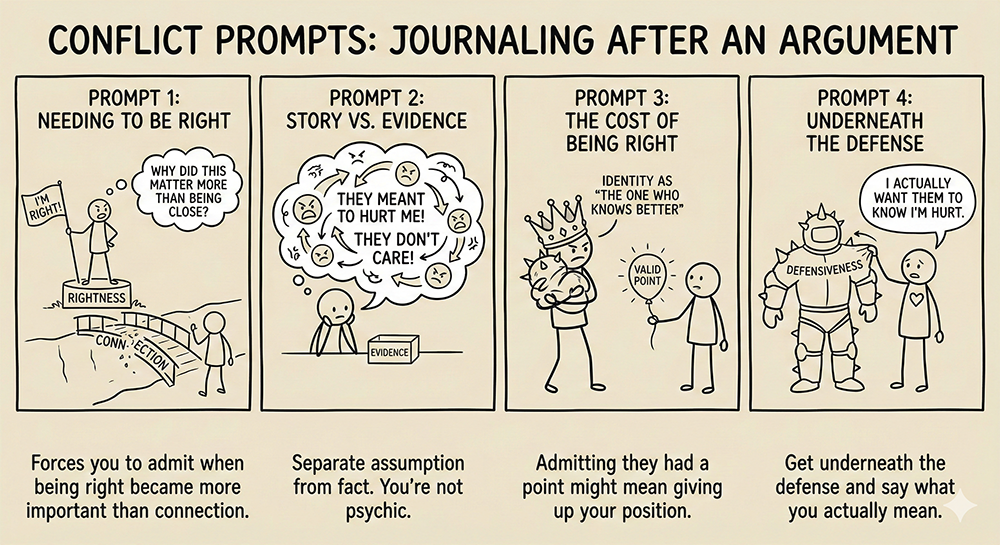
1. What did I need to be right about—and why did it matter more than connection?
Most conflict isn’t about the topic.
It’s about needing to win.
This prompt forces you to admit when being right became more important than being close.
2. What story did I tell myself about their intentions—and what evidence do I actually have?
You’re not psychic.
But your brain will create an entire narrative about what someone meant just to justify how you feel.
This prompt makes you separate assumption from fact.
3. What would I have to give up if I admitted they had a point?
Sometimes you’re not disagreeing because they’re wrong.
You’re disagreeing because admitting they’re right would mean giving up your position, your narrative, or your identity as “the one who knows better.”
This prompt shows you the cost of being right.
4. If I wasn’t trying to defend myself, what would I actually want them to know?
Defensiveness is just protection wearing a loud outfit.
This prompt helps you get underneath the defense and say what you actually mean.
AUTHORITY PROMPTS
Use these after reacting to criticism, correction, or being questioned
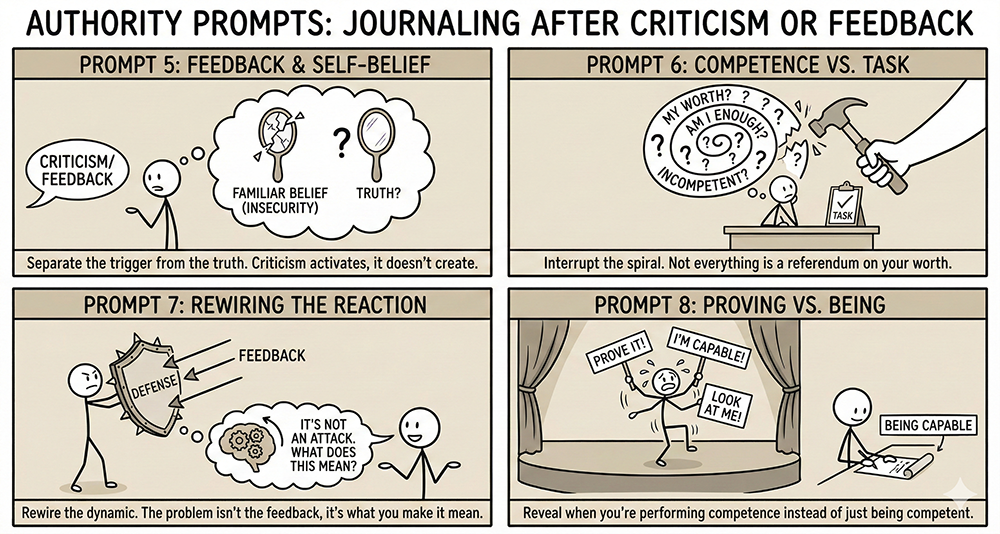
5. What did their feedback make me believe about myself—and is that belief true or just familiar?
Criticism doesn’t create insecurity.
It activates the insecurity that was already there.
This prompt helps you separate the trigger from the truth.
6. What part of me just made this about my competence instead of the task?
Not everything is a referendum on your worth.
But your nervous system doesn’t know that.
This prompt interrupts the spiral before it starts.
7. What would I need to believe about myself to hear this feedback without it feeling like an attack?
This one rewires the entire dynamic.
Because the problem isn’t the feedback.
It’s what you make the feedback mean.
8. If I wasn’t trying to prove I’m capable, what would I do differently?
The need to prove is exhausting.
And it’s also a tell.
This prompt reveals when you’re performing competence instead of just being competent.
REJECTION PROMPTS
Use these after being ignored, excluded, or dismissed
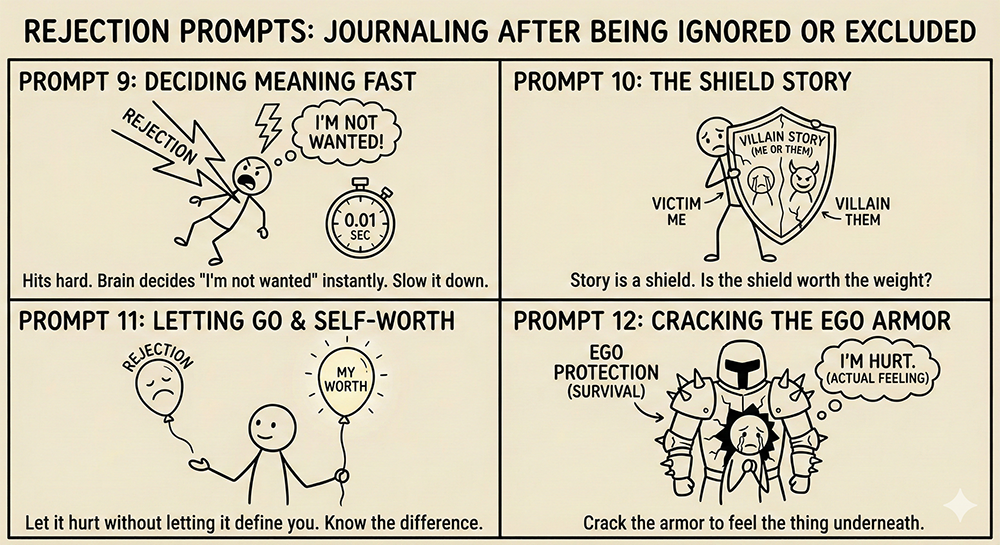
9. What did I decide this meant about me—and how fast did I decide it?
Rejection hits hard because your brain doesn’t wait for context.
It just decides: “I’m not wanted.”
This prompt slows that down.
10. What story am I telling myself to make this hurt less—and is it actually helping?
Sometimes you cope by making the other person the villain.
Sometimes you cope by making yourself the villain.
Either way, the story is a shield.
This prompt asks if the shield is worth the weight.
11. What would I need to believe to let this go without making it mean something about my worth?
You can let something hurt without letting it define you.
This prompt teaches you the difference.
12. If I wasn’t trying to protect my ego, what would I actually feel right now?
Ego protection feels like survival.
But it also keeps you from processing what actually happened.
This prompt cracks the armor so you can feel the thing underneath.
PRESSURE PROMPTS
Use these when you’re overwhelmed, burned out, or trying to control too much.
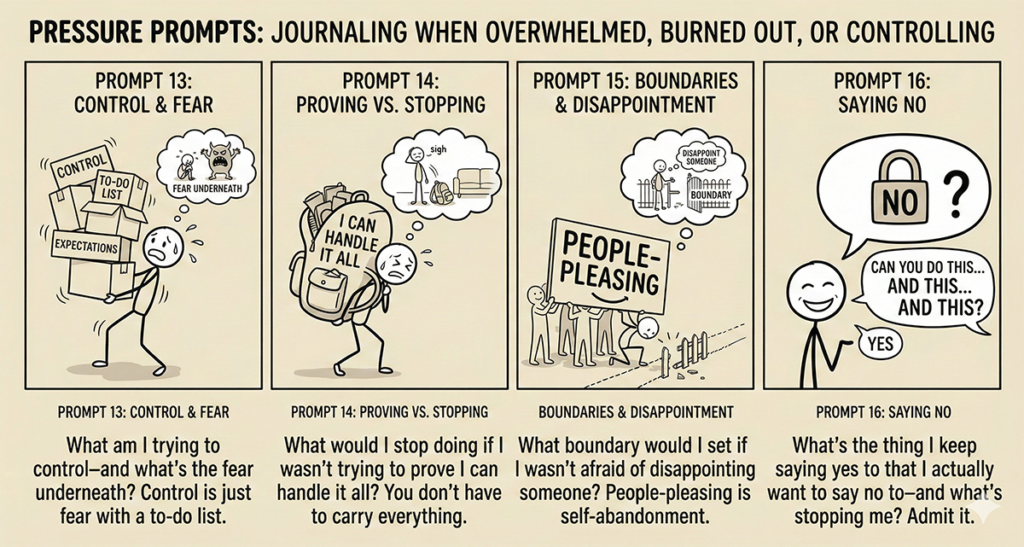
13. What am I trying to control—and what’s the fear underneath the need for control?
Control is just fear with a to-do list.
This prompt gets to the root.
14. What would I stop doing if I wasn’t trying to prove I can handle it all?
You don’t have to carry everything.
But admitting that feels like failure.
This prompt gives you permission to put something down.
15. What boundary would I set if I wasn’t afraid of disappointing someone?
People-pleasing isn’t kindness.
It’s self-abandonment with good PR.
This prompt shows you where you’ve been negotiating with yourself to keep others comfortable.
16. What’s the thing I keep saying yes to that I actually want to say no to—and what’s stopping me?
You know the answer.
You just haven’t admitted it yet.
This prompt makes you say it out loud.
How to Use These Without Turning Journaling Into a Part-Time Job
Don’t answer them all.
Pick one prompt.
The one that makes your stomach tighten when you read it.
Write for 3-5 minutes.
No editing. No performing. No trying to sound insightful.
Just raw, messy honesty.
Then close the notebook and move on.
You don’t need to “process” it further.
You don’t need to share it with anyone.
You just needed to see it.
And once you see it, the pattern starts to lose power.
Real-World Examples: Prompts in Practice
Example 1: Using a Conflict Prompt After a Fight
The Situation: You and your partner argued about plans. You insisted your way was better. They said you never listen. You hung onto “never” and spiraled.
The Prompt: “What did I need to be right about—and why did it matter more than connection?”
The Answer (3 minutes, raw): “I needed to be right about the restaurant choice because when they said I ‘never listen,’ I made it mean I’m controlling. And if I’m controlling, then I’m the problem. So I had to prove the restaurant thing was logical, not controlling. But I stopped listening to them to prove I listen. Which is insane.”
The Result: You see the loop. You text them: “You’re right. I stopped listening. Want to pick the place?”
The fight ends. Connection restored.
Example 2: Using an Authority Prompt After Feedback
The Situation: Your boss points out an error in your report. You immediately over-explain why it happened, listing three reasons it wasn’t really your fault.
The Prompt: “What part of me just made this about my competence instead of the task?”
The Answer (2 minutes, messy): “I made the error mean I’m bad at my job. So I had to prove it was an outlier, not evidence. But it was just a typo. She wasn’t questioning my competence—I was.”
The Result: You stop defending. You fix the error. You move on.
No story. No shame. Just correction.
Common Mistakes When Using Journal Prompts
Mistake #1: Journaling About the Other Person More Than Yourself
If 80% of your entry is about what they did, you’ve lost the plot.
Shadow work is about your reactions, not their actions.
Flip the focus back to yourself.
Mistake #2: Turning Prompts Into Therapy Homework
These aren’t assignments.
You don’t need to answer every prompt in every category.
Pick one. Answer it. Move on.
If you’re creating a “journal routine” with multiple prompts per sitting, you’re performing—not practicing.
Mistake #3: Writing Until You Feel Better
Shadow work journaling isn’t supposed to make you feel good.
It’s supposed to make you see clearly.
If you’re writing to soothe yourself, you’ve crossed into emotional regulation—not pattern interruption.
Mistake #4: Waiting Until You’re Calm to Write
The prompt works best when used immediately after the reaction.
Not later that night.
Not the next morning when you’ve “processed.”
Right when it’s still raw.
That’s when the truth is clearest.
Frequently Asked Questions About Shadow Work Journal Prompts
How many prompts should I answer per day?
One. Maybe two if you had multiple big reactions. But if you’re answering five prompts a day, you’re either over-processing or turning journaling into a coping mechanism instead of a diagnostic tool.
What if I can’t answer a prompt honestly?
Then that’s the prompt you need to sit with. The resistance is the tell. Write “I don’t want to answer this because…” and see what comes up. The avoidance is data.
Can I use these prompts in therapy?
Yes. Many therapists use shadow work prompts as homework between sessions. But make sure your therapist understands that shadow work is about interception, not excavation. If they turn it into deep childhood exploration, you’ve left shadow work territory.
What if journaling makes me feel worse?
If you’re spiraling into shame, hopelessness, or rumination, stop writing. You’ve gone too deep or stayed too long. Shadow work journaling should feel uncomfortable but clarifying—not crushing. Set a 5-minute timer. When it goes off, close the notebook. No exceptions.
Do I need to keep my old journal entries?
Yes—at least for a few months. The power is in seeing the same pattern show up repeatedly. Skim your entries weekly. Look for recurring themes. That’s where the real insight lives.
What’s the difference between these prompts and regular journal prompts?
Regular prompts ask: “How do I feel about this?”
Shadow work prompts ask: “What am I defending that I don’t actually believe?”
One invites exploration. The other forces confrontation.
What Happens When You Do This Consistently
You start catching yourself mid-reaction.
Not every time.
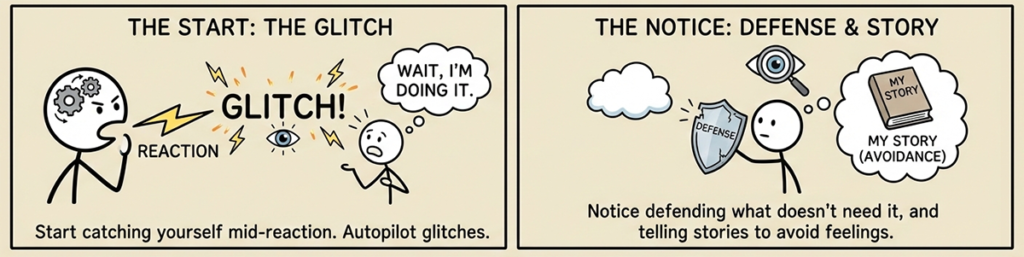
But enough that the autopilot starts to glitch.
You notice when you’re making something about you that isn’t.
You notice when you’re defending something that doesn’t need defending.
You notice when you’re telling yourself a story to avoid a feeling.
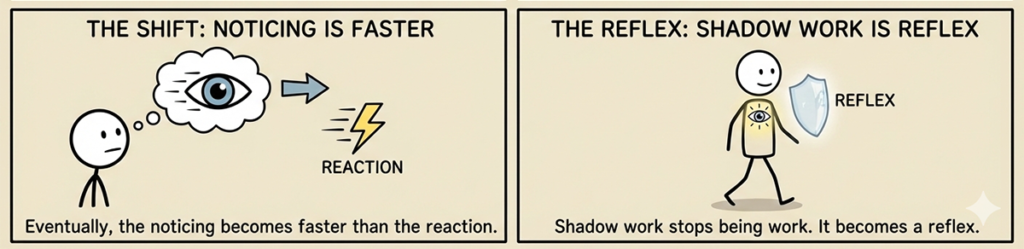
And eventually? The noticing becomes faster than the reaction.
That’s when shadow work stops being work. And starts being reflex.
Where to Go From Here
If you want the full system—the one that makes shadow work automatic instead of optional—start here:
Get the system that turns this into muscle memory
Continue Your Shadow Work Practice:
- The Shadow Work Journal: What It Is and Why It Works
Learn the system behind tracking reactions without spiraling. - Journaling for Shadow Work (Without Getting Lost in Your Own Head)
Time limits, boundaries, and when to stop writing. - Shadow Work Questions That Cut Straight Through the Noise
Short, brutal questions that dismantle narratives instantly.
Ready for the Complete System?
Our full shadow work framework includes:
- Categorized prompt library (conflict, authority, rejection, pressure)
- Reaction tracking templates
- Pattern recognition exercises
- Monthly review protocols
Start the program here → (link to Master Sales Page)
Because here’s the truth:
The right question, written at the right time, can expose a pattern you’ve been running for years.
But only if you’re willing to answer it honestly.
And only if you’re willing to stop making yourself the hero of every story you tell.
The prompts are here.
The rest is up to you.
Are Shadow Work Journal Prompts the same as Shadow Work Prompts?
No. Shadow Work Prompts define the system that is used to make the observations. Journal prompts usually include the recording or the written format of the observations within this procedure. Shadow work provides the awareness while the journal is used to keep the record.
Do I need a journal to use these prompts?
A journal is commonly used, but any written record that preserves responses without alteration serves the same purpose.
Are these prompts therapeutic?
No. They are purely observational.
Can these prompts be used daily?
They may be used whenever responses occur. Frequency is not prescribed by the framework.
Summary
Shadow Work Journal Prompts are a self-directed, observational writing format.
They do not aim to change behavior, interpret meaning, or produce outcomes.
Their sole function is to make patterns visible through consistent recording.