Let’s talk about the difference between a diary and a weapon.
A diary is where you write about your day. The shadow work journal is where you write about the moment you almost ruined your day, and why.
One is documentation. The other is interception training.
And if you’ve ever filled notebooks with feelings and wondered why nothing changed, this is why:
You were recording the weather instead of tracking the storm system.
What a Shadow Work Journal Actually Is
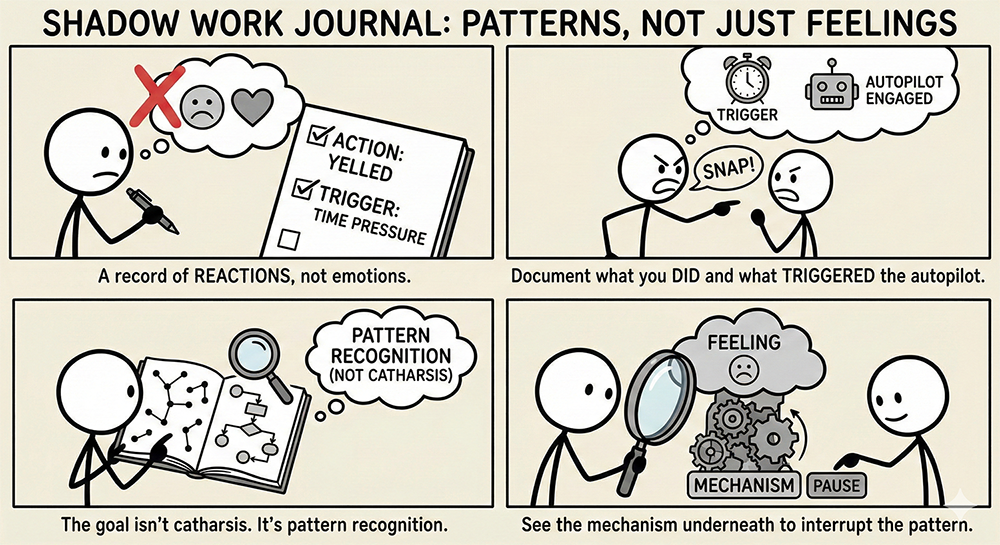
A shadow work journal is a record of reactions, not emotions.
It’s not a place to explore how you feel.
It’s a place to document what you did when you felt something and what triggered the autopilot.
The goal isn’t catharsis. It’s pattern recognition.
Because once you can see the pattern, you can interrupt it.
But you have to see it first.
And most people never do, because they’re too busy writing about the feeling to notice the mechanism underneath.
Why Most People Use Journals Wrong
They treat it like therapy.
They write until they feel better.
They explore their thoughts. They process their emotions. They give themselves permission to feel what they feel.
And look, there’s nothing wrong with that. But it’s not shadow work.
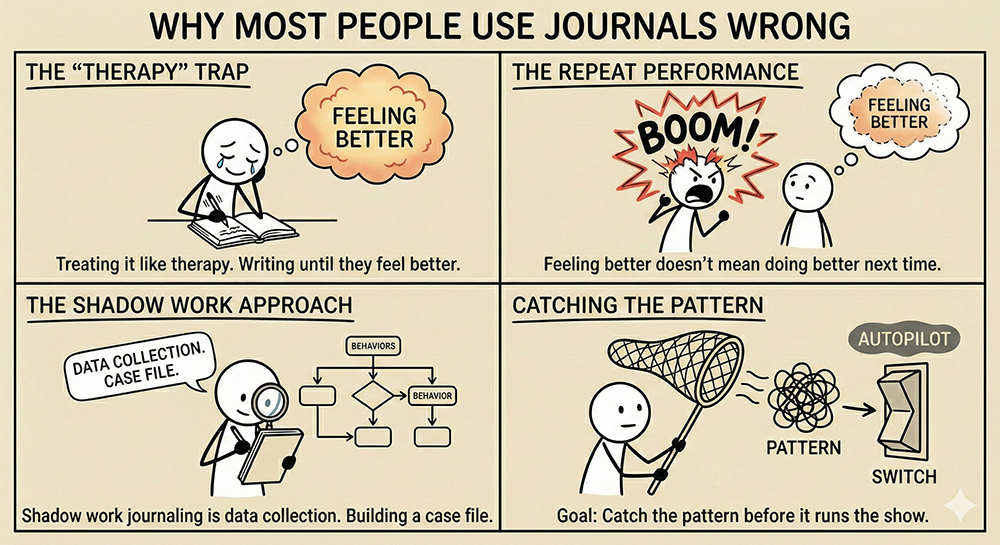
Because feeling better doesn’t mean doing better the next time the same thing happens.
Shadow work journaling isn’t about release.
It’s about data collection.
You’re building a case file on yourself.
And the goal is to catch the pattern before it runs the show.
What Makes a Shadow Work Journal Different
It’s Short
If you’re writing three pages, you’re writing too much.
Shadow work entries are:
- Two to five sentences
- Focused on the moment, not the mood
- Written immediately after the reaction (or as close to it as possible)
Because the longer you wait, the more your brain will edit the story to make you look better.
It’s Specific
No vague feelings. No “I felt sad today.”
Shadow work journaling captures:
- What happened (the trigger)
- What you did (the reaction)
- What you were actually defending (the mechanism)
Example:
“Boss questioned my timeline. I got defensive and over-explained. I was defending my competence because I made the question mean I wasn’t trusted.”
That’s it. That’s the whole entry. And it’s enough.
It’s Focused on Action, Not Insight
You don’t need to understand why you reacted.
You just need to see that you did.
Insight is overrated. Interruption is everything.
The journal isn’t there to help you figure yourself out.
It’s there to show you the pattern until you can’t ignore it anymore.
What to Actually Write (And What to Skip)
WRITE THIS:
- The moment you reacted bigger than the situation required
- The story you told yourself to justify the reaction
- The thing you were defending (even if it wasn’t under attack)
- The early warning signs you missed (or ignored)
SKIP THIS:
- How the other person made you feel
- Why you think they did what they did
- The full backstory of why you’re sensitive to this
- Affirmations about how you’re going to do better next time
The journal isn’t a feelings diary. It’s a reaction log. And the cleaner you keep it, the faster you’ll see the pattern.
Why This Works (Even When It Feels Pointless)
Because your brain hates being caught.
The first time you write down a reaction, it feels like documentation.
The third time you write down the same reaction?
It feels like evidence. And by the tenth time? You can’t pretend it’s not a pattern anymore.
That’s when the change starts. Not because you’ve healed.
But because you’ve seen yourself do the same thing enough times that the autopilot starts to glitch.
The reaction still wants to happen. But now there’s a split second of recognition:
“Oh. I’m doing the thing again.”
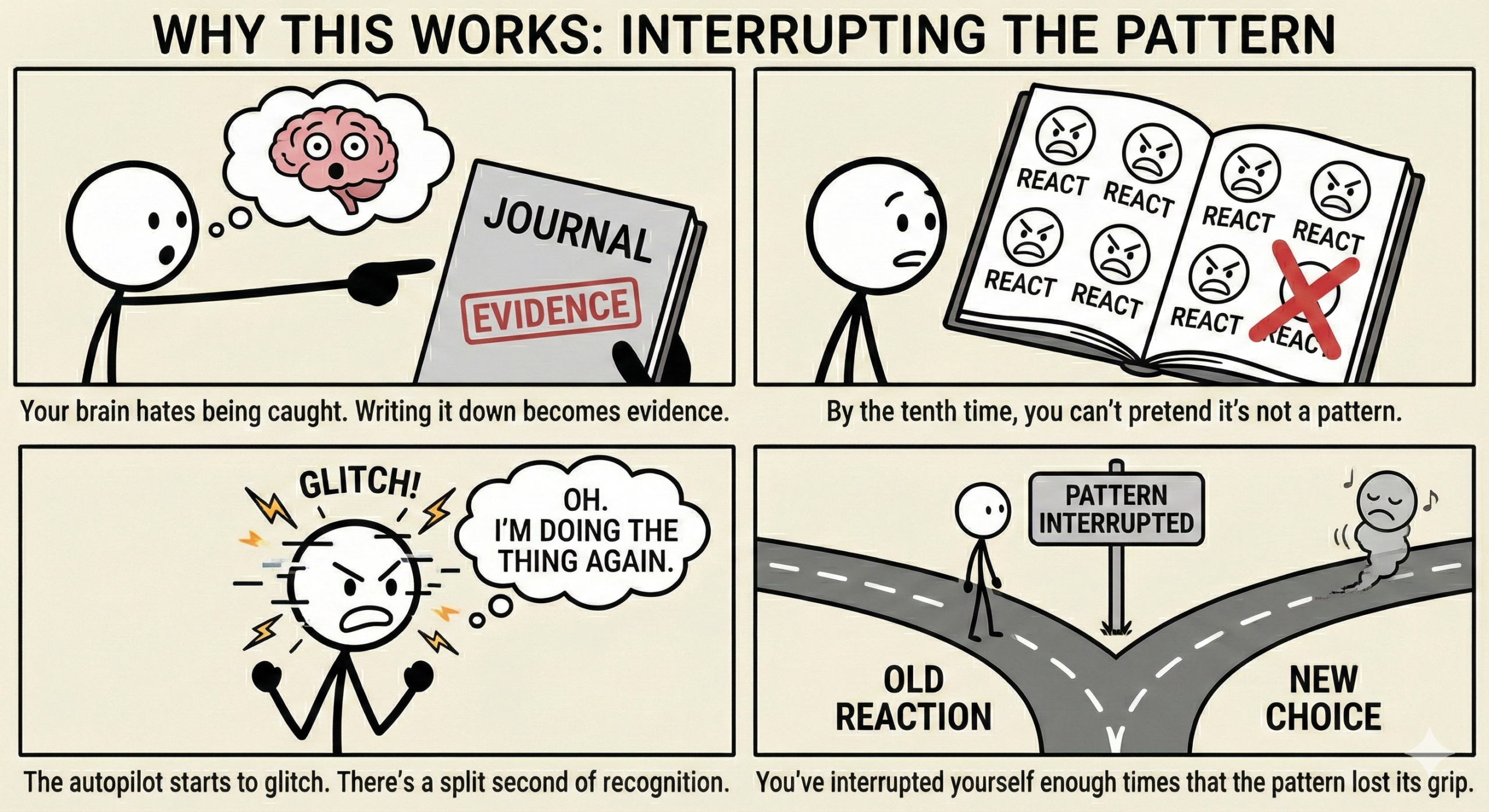
And in that split second, you have a choice. Most of the time, you’ll still do the thing.
But eventually, after enough repetitions, the choice becomes easier.
And the reaction becomes quieter. Not because you’ve fixed yourself.
Because you’ve interrupted yourself enough times that the pattern lost its grip.
How to Use the Journal Without Turning It Into Another Self-Help Project
Daily: Write one entry. Just one.
Pick the moment that stood out most, the one where you reacted and immediately wished you hadn’t.
Weekly: Skim the last seven entries.
Look for the pattern. What keeps showing up? What’s the common thread?
Monthly: Compare this month to last month.
Are you reacting to the same things? Are you catching yourself sooner?
Are the reactions getting quieter? If yes, keep going. If no, look at what you’re avoiding writing about.
Because the thing you’re not documenting is probably the thing running the show.
What the Journal Reveals (That Talking About It Never Does)
When you talk about a reaction, you get to edit it in real time.
You get to make yourself sound more reasonable.
You get to explain why it made sense.
But when you write it?
There’s no audience to perform for.
Just you and the page. And the page doesn’t let you lie.
Over time, the journal shows you:
- The same trigger keeps activating the same defense
- The story you’re telling yourself is almost always the same story
- The thing you’re defending isn’t actually under threat
- The reaction you think is “justified” is actually just familiar
And once you see that clearly enough? The reaction starts to feel optional.
Not easy to stop. But possible to stop. And that’s the entire game.
What Happens When You Actually Do This
You don’t transform. You don’t become a different person.
You just become someone who notices sooner.
The reaction still happens. But the moment between trigger and launch gets longer.
And in that moment, you start making different choices.
Not because you’ve healed some deep wound.
But because you’ve practiced catching yourself enough times that it becomes reflex.
That’s what the journal does. It turns shadow work from a concept into a skill.
The Silent Shift No One Warns You About
The more you use the journal, the less you need the journal.
Because the act of writing it down trains your brain to notice the pattern in real time.
Eventually, you don’t need to document the reaction.
You catch it mid-launch.
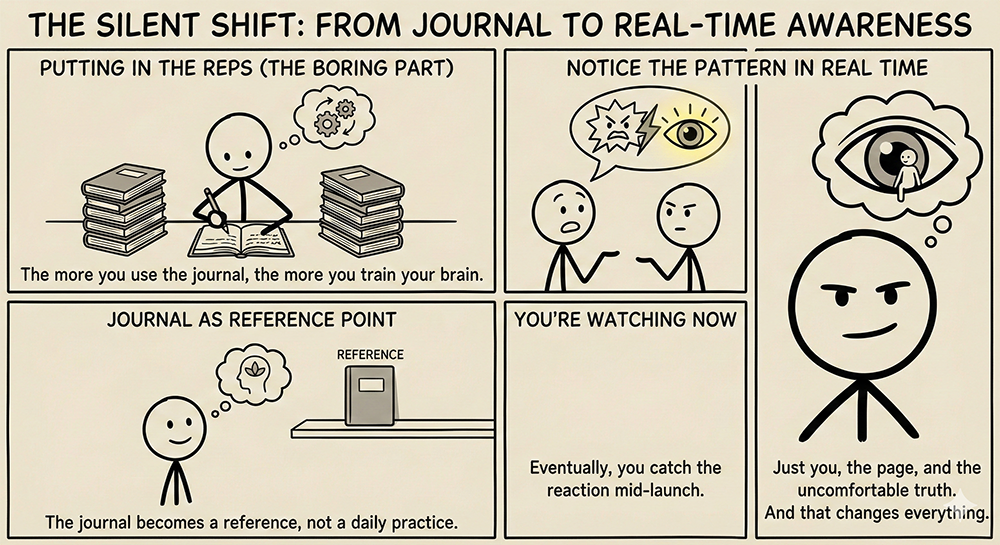
And the journal becomes a reference point instead of a daily practice.
But you have to put in the reps first. No shortcuts. No skipping the boring part.
Just you, the page, and the uncomfortable truth about what you keep doing when you think no one’s watching.
Except you’re watching now. And that changes everything.
Where to Go From Here
If you want the full system, the one that makes shadow work automatic and makes the journal actually work: start here:
Get the system that makes this automatic.
Or if you want to go deeper into the how of journaling:
- Journaling for Shadow Work (Without Getting Lost in Your Own Head)
- Shadow Work Journal Prompts for When Writing Finally Clicks
Because here’s the truth:
The journal doesn’t fix you.
It just makes it impossible to pretend you don’t see the pattern.
And once you see it clearly enough, the pattern starts to crack.
Not because you wanted it to.
Because you finally stopped letting it hide.