Shadow work is a reflective psychological practice focused on identifying suppressed emotions, recurring emotional triggers, and unconscious behaviors through structured journaling and guided questioning.
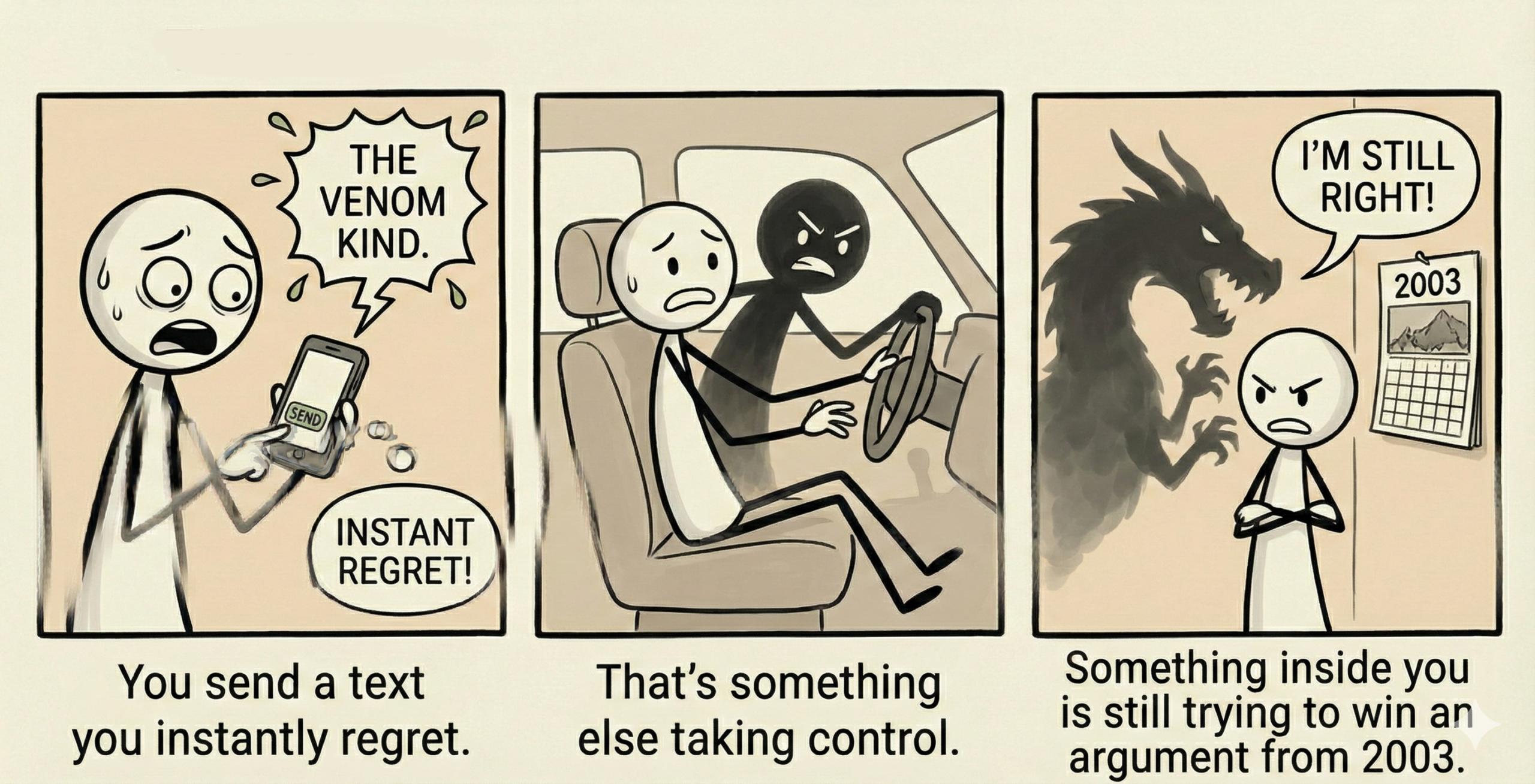
You know that moment when you send a text you instantly regret?
Not the typo kind. The venom kind.
The one where your finger hits send and your stomach drops because you just said something that came from a place you didn’t even know was loaded.
That’s not you losing control. That’s something else taking control.
You didn’t plan to react that way. It just happened. And it’s been doing it longer than you think.
Shadow work will bring this to the surface.
The Thing That Drives Before You Realize You’re In The Car
Shadow work refers to the process of confronting internal reactions that operate outside conscious choice.
Translation: It’s the work of catching yourself mid-launch when you’re about to blow up a conversation, a relationship, or your own day and asking a question you’ve been avoiding.
Not “Why do I feel this way?”
More like: “What part of me just grabbed the wheel?”
Because here’s the truth most self-help avoids:
You don’t react because you’re broken.
You react because something inside you is still trying to win an argument from 2003.
Shadow work will help you unearth it too.
It’s Not About Feelings. It’s About Patterns.
Shadow work isn’t therapy-lite.
It’s not journaling your way to inner peace while sipping oat milk and pretending you’ve transcended your triggers.
It’s the practice of identifying the specific moments when your nervous system decides you’re under threat and responds accordingly.
Shadow work begins after the reaction, when the damage is already in motion and you’re left asking,
“Why did that come out of me?”
Even when you’re just being asked to load the dishwasher.
Shadow work reveals every part of you that:
- Learned to protect itself before you had language for it
- Made a rule about safety that no longer applies
- Reacts faster than thought because it thinks it’s saving your life
It shows up as:
- Defensiveness when no one attacked you
- Rage that’s three sizes too big for the situation
- Shutting down when someone just asked a simple question
Sound familiar?
Good. That means you’re paying attention.
The Worst Part? You Can’t Think Your Way Out.
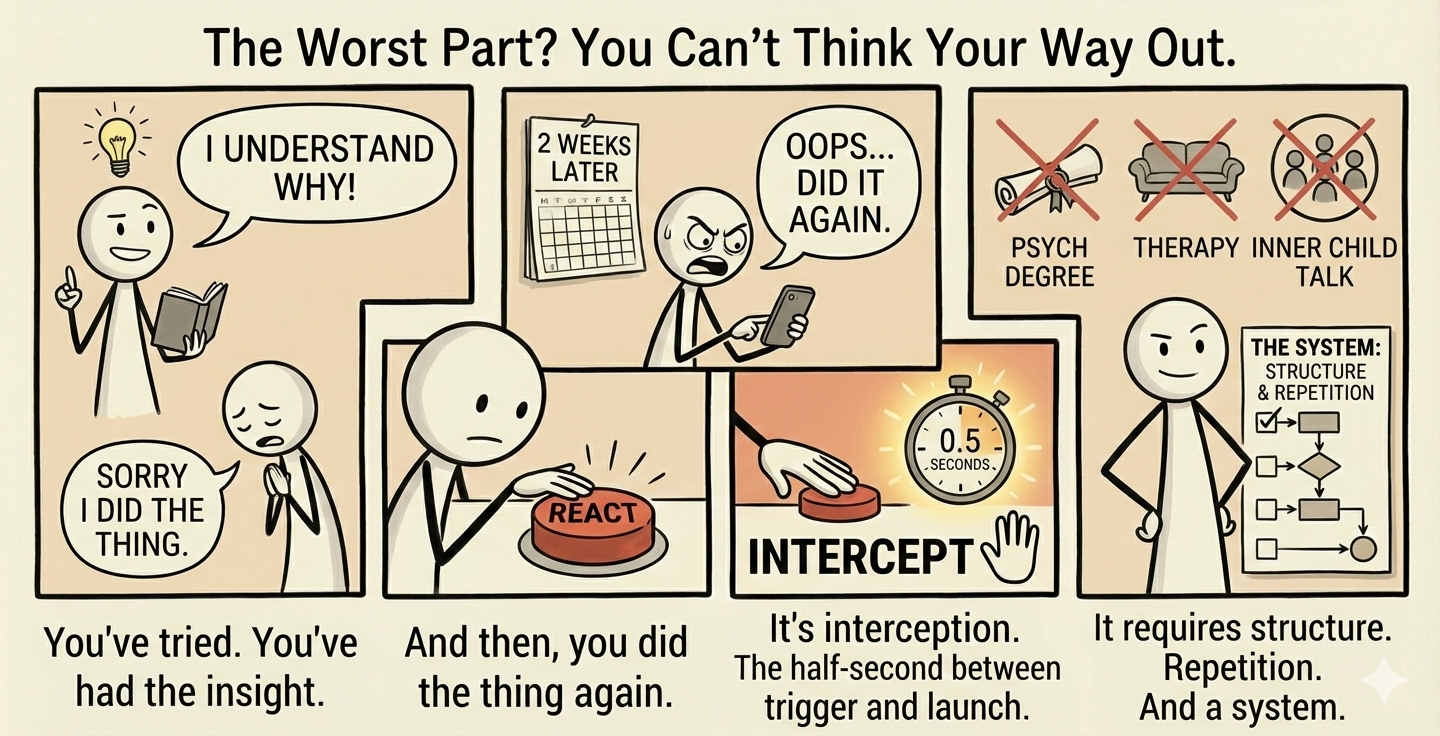
You’ve tried.
You’ve had the insight. You’ve understood why you do the thing.
You’ve even apologized for doing the thing.
And then, two weeks later,you did the thing again.
Because shadow work isn’t intellectual.
It’s interception.
It’s learning to spot the moment before the reaction takes over. The half-second between trigger and launch.
That’s the gap where everything changes.
And no, it doesn’t require:
- A degree in psychology
- Childhood trauma archaeology
- Sitting in a circle talking about your inner child
It requires structure. Repetition. And a system that doesn’t let you off the hook with pretty language.
Why It Shows Up When You Least Expect It
Because you don’t get to schedule your nervous system.
Shadow work moments don’t announce themselves politely.
They happen:
- In the middle of a work meeting when someone questions your idea
- On a Tuesday morning when your partner uses the wrong tone
- When you’re scrolling Instagram and suddenly feel like your life is a joke
The shadow doesn’t wait for you to be ready.
It shows up when something brushes against the part of you that’s still guarding something old.
And the faster you learn to recognize it, the less it runs your life.
What This Actually Looks Like
Let’s say someone criticizes your work.
Without shadow work: You either shut down, lash out, or silently replay the interaction for three days while your brain generates comeback speeches you’ll never deliver.
With shadow work: You feel the reaction start. You notice it. You pause long enough to ask: “What just got activated? What am I actually defending right now?”
And instead of reacting from the wound, you respond from the present.
That’s it.
That’s the entire game.
The Part No One Tells You
Shadow work doesn’t make you calm.
It makes you conscious.
You still feel the rage, the shame, the fear.
But you stop letting it make decisions for you.
You stop handing your nervous system the microphone every time something feels slightly threatening.
And over time?
You realize most of what you thought was “just how you are” was actually just unexamined wiring.
Real-World Examples: What Shadow Work Actually Looks Like
Because theory is useless without application.
Example 1: The Work Meeting Explosion
The Situation: Your manager questions your project timeline in front of the team.
Without Shadow Work: You immediately get defensive. Your voice gets tight. You over-explain every decision you made, proving why your timeline is correct. You leave the meeting feeling attacked and spend the rest of the day replaying what you should have said.
With Shadow Work: You feel the heat rising in your chest. You notice it. You pause. You ask yourself: “What am I actually defending right now?”
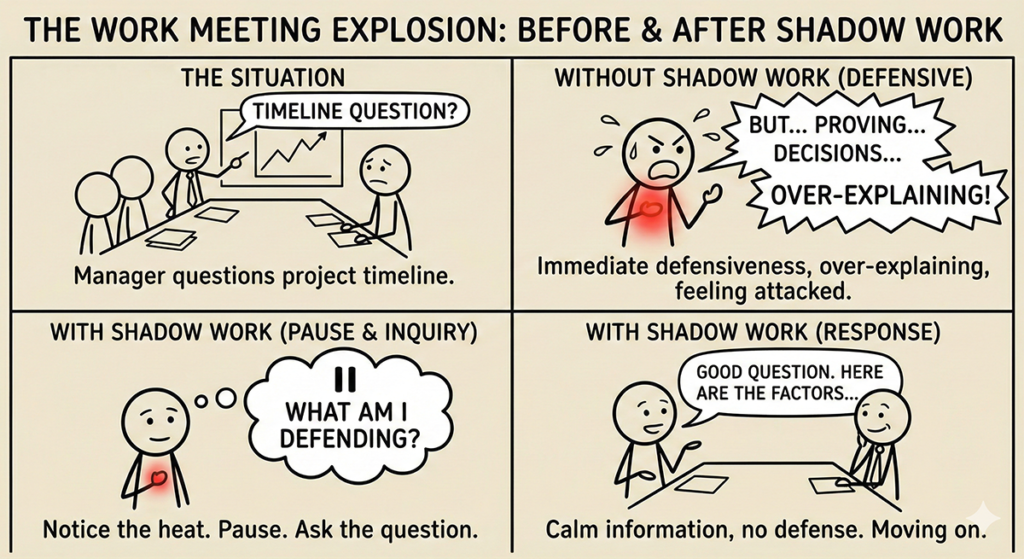
Answer: Your competence. Because the question made you feel like you weren’t trusted.
You realize the question wasn’t an attack, it was just a question.
You respond: “Good question. Let me walk through the factors that went into the timeline.”
No defense. No over-explanation. Just information.
The meeting ends. You move on with your day.
Example 2: The Partner Comment That Ruins Dinner
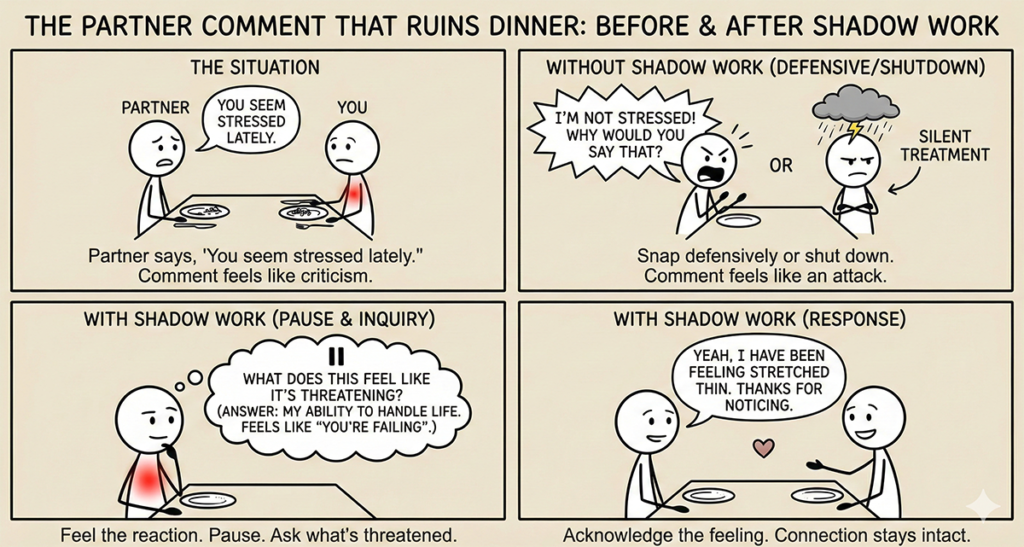
The Situation: Your partner says, “You seem stressed lately.”
Without Shadow Work: You snap: “I’m not stressed. Why would you say that?”
Or you shut down completely and go silent for the rest of the meal.
Either way, the comment which was probably meant as concern becomes evidence that they don’t understand you.
With Shadow Work: You feel the reaction starting. That urge to defend or retreat.
You pause.
You ask: “What does this feel like it’s threatening?”
Answer: Your ability to handle your life. Because “you seem stressed” sounds like “you’re failing.”
But that’s not what they said.
You respond: “Yeah, I have been feeling stretched thin. Thanks for noticing.”
The conversation continues. Connection stays intact.
Example 3: The Instagram Comparison Spiral
The Situation: You’re scrolling. You see someone’s post about their success, their vacation, their perfect life.
Without Shadow Work: You immediately feel like your life is small. You spiral into comparison. You close the app feeling worse than when you opened it. The rest of your day is tinted with inadequacy.
With Shadow Work: You notice the feeling. That sinking sensation.
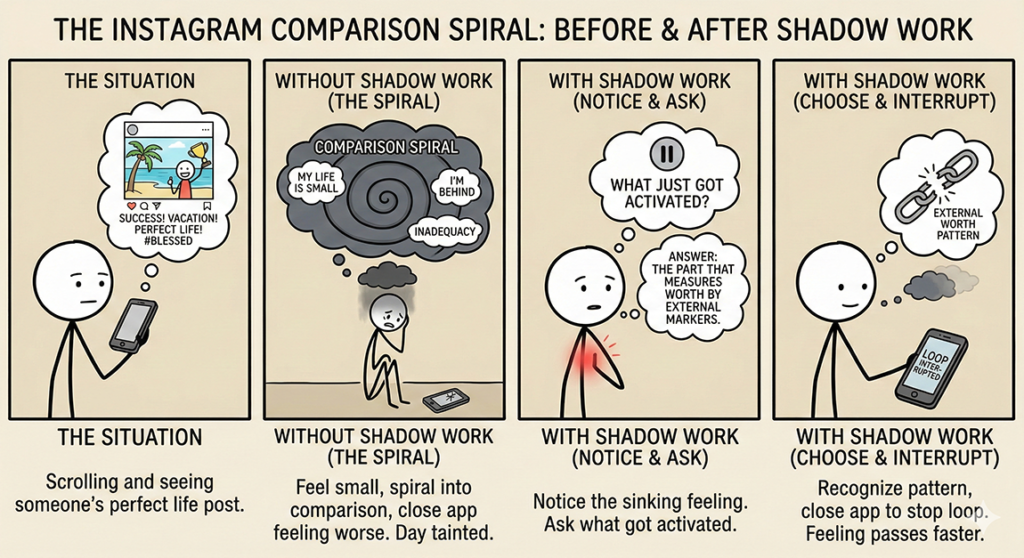
You ask: “What just got activated?”
Answer: The part of you that measures your worth by external markers.
You recognize the pattern. You close the app, not because you’re “above it,” but because you see what’s happening.
You choose not to feed the loop.
The feeling passes faster because you didn’t pile a story on top of it.
Common Mistakes People Make With Shadow Work
Mistake #1: Treating It Like Therapy
Shadow work isn’t about understanding why you react.
It’s about catching yourself mid-reaction and choosing differently.
If you’re spending more time analyzing your childhood than interrupting your current patterns, you’re doing therapy , not shadow work.
Both are valuable. But they’re not the same thing.
Mistake #2: Waiting Until You’re Calm to Reflect
The work happens in the heat.
Not three hours later when you’ve already calmed down and edited the story to make yourself look better.
If you only do shadow work when you’re already calm, you’re not training the skill you actually need.
Mistake #3: Confusing Awareness With Change
“I know I do this” doesn’t count as shadow work.
Knowing the pattern and interrupting the pattern are completely different skills.
Awareness without action is just spectating your own life.
Mistake #4: Using It to Beat Yourself Up
Shadow work isn’t about shame.
It’s about observation.
If your inner dialogue after noticing a pattern is “I’m so broken” or “Why do I always do this?”—you’ve turned shadow work into self-punishment.
The goal is to see the pattern, not to hate yourself for having it.
Mistake #5: Expecting It to Make You “Healed”
Shadow work doesn’t fix you.
It makes you conscious.
You’ll still feel the rage, the defensiveness, the urge to shut down.
But you’ll stop letting those reactions make decisions for you.
That’s not healing. That’s skill-building.
And it’s enough.
What is shadow work used for?
Shadow work is used to interrupt unconscious reactions that damage relationships, careers, and your own sense of control. It’s applied in moments of conflict, defensiveness, shame, or emotional reactivity ,anywhere your autopilot takes over and you later regret what you said or did. The primary use is pattern interruption, not emotional healing.
Is shadow work dangerous?
Shadow work isn’t dangerous, but it can be uncomfortable. It forces you to look at patterns you’ve been avoiding. For most people, this discomfort is manageable and necessary. However, if you have unprocessed trauma, severe mental health conditions, or a history of dissociation, working with a trained therapist is recommended before attempting shadow work alone. The practice itself isn’t harmful but going too deep without support can be destabilizing.
How long does shadow work take?
There’s no finish line. Shadow work is a practice, not a program. Most people start noticing patterns within 2-4 weeks of consistent practice. Actual behavior change—where you interrupt reactions in real time. This usually takes 8-12 weeks of daily attention. But the skill compounds over time. The longer you practice, the faster you catch yourself.
Can I do shadow work alone?
Yes. Shadow work doesn’t require a therapist, coach, or group. It requires honesty and repetition. Many people do shadow work entirely on their own using journals, prompts, and self-observation. That said, having structure helps. Without a system, most people either go too shallow (journaling without changing) or too deep (ruminating instead of interrupting).
How is shadow work different from therapy?
Therapy explores the why behind your patterns. This often dives into childhood, attachment styles, and root causes. Shadow work focuses on the what and when while identifying the exact moment a reaction starts and learning to interrupt it. Therapy is excavation. Shadow work is interception. Both are valuable, but they serve different purposes.
What if I don’t know what my shadow is?
You don’t need to “find” your shadow. It shows up on its own,every time you overreact, shut down, or defend something that wasn’t even under attack. Pay attention to moments when your response is bigger than the situation requires. That’s your shadow making itself known. You don’t need to hunt for it. You just need to start noticing it when it appears.
Does shadow work make you less emotional?
No. Shadow work doesn’t make you less emotional, it makes you less reactive. You still feel anger, fear, shame, and defensiveness. But you stop letting those emotions run the show. You feel the feeling without obeying it. That’s the difference.
Where to Go From Here
If you’re ready to stop reacting on autopilot and start intercepting the patterns that keep running your life, the next step is simple:
Learn the system that actually works
Continue Your Shadow Work Education:
- How to Do Shadow Work Without Turning It Into a Personality Project →
Get the step-by-step process for interrupting reactions in real time. - Shadow Work Questions That Cut Straight Through the Noise →
Use these questions to dismantle the stories you tell yourself. - Shadow Work Prompts That Don’t Waste Your Time →
Prompts designed to expose patterns, not make you feel seen.
Ready to Go Deeper?
If you want a complete system that makes shadow work automatic—not something you have to remember to do—our framework gives you:
- Daily interception training
- Pattern recognition exercises
- Real-time reaction logs
- Monthly progress tracking
Get the full Shadow Work system here →
Because understanding what shadow work is?
That’s the warm-up.
Doing it consistently enough that it changes your life?
That’s the real work.
And it starts the second you stop explaining yourself and start watching yourself instead.